Sunday, January 31, 2021

Fuck the Orthodoxy!


If you decide to try to teach yourself to oil paint, you're going to do a lot of reading and watching Youtube videos, and in the course of this self-education you're going to come to realize that there is an orthodoxy to the whole thing; a few ways that things are 'supposed to be done.'

A few of these 'rules,' for example, are:

• Start by painting the large forms, and when the large forms of color and value are in place, then you can get smaller and more detailed.

• It's a mistake to 'draw with paint'; the correct approach is to 'paint with paint.' What this means, I think, is that you're supposed to put down large volumes of paint and visually describe your subject with big marks of color and value, as opposed to lines or small meticulously made marks. You're supposed to use the liquid qualities of paint, which are fundamentally different from the 'dry' qualities of pencils and charcoal.

• Brushwork should be loose and expressive, in the style of John Singer Sargent. 

A few weeks ago I had a kind of an epic fail in the painting studio, and in retrospect I think the real reason is that I was trying to get in line with the orthodoxy. But it didn't work for me. After a lot of frustration I decided to forget these rules and just start putting paint on the canvas. This worked much better for me. This is the result:


Despite the fact that I have heard, from various sources, that "Painting should be something you enjoy," I often find it excruciatingly difficult. I crash against my own limitations... physical, emotional, psychological... all the time. But I'm painting because I have images in my head that I want to get out. These images deserve to be materialized. And so I am working on a craft, the craft of painting, in order to make these images real.

(It has occurred to me that I could do this with photography mixed with photoshop... the craft which is known as 'photo illustration.' I enjoy photo illustration, and I do a certain amount of it in service of the images I want to paint, but... at the end of the day all you really have is a print. A print is not an 'art object' in the same way that a painting is. And that is important to me. In addition to making art I also collect art and there is no replacement for the magic of holding in your hands an object that was made by the artist. That is important.)

So at this point I'm sort of in a "The ends justify the means" phase. I want a certain result and I do what it takes to get that result, which in my case means that I do very careful drawings and I rather meticulously match values and colors to my source images. It's slow and quite 'anal.' I don't put down big expressive slabs of paint; in fact I tend to draw with paint. Oh well. 

What follows is a gross oversimplification, but bear with me. 

Let's posit the painting style of photo-realism as one extreme. It is a style in which neither the content of the painting nor the technique of the painting deviates from objective visual reality. The subject is just a real scene, and the brush strokes are tight and unobtrusive, unnoticeable. From this extreme, a painter may deviate in one of two ways, either by distorting the content (towards surrealism or other distortions of reality), OR by distorting the technique of the painting (towards looser and looser brush strokes, or graphical abstraction). 

If we plot "Distortion of Content" along one axis, and "Distortion of Technique" along the other axis, we can get a graph that looks like this:


In theory, every painter who ever painted could be plotted somewhere on this graph. For some of them, it's quite difficult to evaluate them... and this is at best a very imprecise and subjective 'science.'
Here are some artists that come to mind, plotted on the graph (again, these are my estimations and they are approximate)


Now it so happens that I have a preference for paintings which display a medium-level distortion of content and a low-level distortion of technique... such as seen in the blue zone:


(Mind you, there are artists within the blue zone that I don't like, as well as artists outside the blue zone that I do like. This mainly comes down to subject matter. For instance I don't like Botero (too precious and cute) but I do like Bacon and Basquiat (because their paintings are tortured and dark and have so much energy.)

So the logical question that arises from all this is: If I like the tight and controlled paintings of Gottfried Helnwein, Paul Cadmus, and Mati Klarwein, and if I want to produce paintings like these, then should I be bothered at all about 'loose and expressive brushwork'? No, I don't think so. Helnwein and Cadmus and Klarwein certainly never gave a fuck about how Youtube told them to paint. Fuck the orthodoxy.

And anyway, every time I find painting difficult, I just remember the wise words of the very talented Jeff Cochran, "You are not supposed to enjoy painting. It's a battle/war/work."

____________________________

Total change of topic. 
I've met a fair number of famous people over the years, and it's occurred to me to write some of those stories down. Some people will find this tacky, or think: "what is he trying to prove with these stories?" I don't think I'm trying to prove anything; mostly I just want to catalogue these stories before I forget them. Some of the stories are good.
Most of these took place while I was living in NYC and LA.

I met Leonard Cohen and shook his hand and told him how much his music always meant to me, at Coachella in 2009. I discussed this meeting previously on this blog.

I also briefly met Perry Farrell at Coachella.

I met the amazing J.G. Thirlwell (Foetus) after a show in Los Angeles, some time around 2004. My brother Trevor is kinda friends with Thirlwell.

I met Michael Gira of the SWANS briefly in San Francisco after a concert in 2015. 

I met Marilyn Manson in LA some time around 2003 or so, at one of those beautiful downtown theaters. I saw him sitting a few seats away from where I was, and worked up the courage to go talk to him. As I approached, his bodyguards tried to block me but he waved them off. I told him about my robot performances and gave him a business card. He was nice and actually sort of enthusiastic about the robots. I'm sure I complimented him about his music, which I liked a lot then, and still mostly do.

On different occasions I met two members of the band Einstürzende Neubauten; Blixa Bargeld in LA, and N.U. Unruh in Amsterdam. I have always liked this band, but both of these guys were genuine assholes, and these meetings had a definite negative impact on my tendency to listen to them.

I met Jon Favreau when working on the effects for Zathura. He noticed a picture of an ultrasound of Kodiak, in utero, that I had at my desk and we talked briefly about having children.

I met Steven Spielberg while working on A.I. Artificial Intelligence, and then had a slightly longer chat with him a few years later working on War of the Worlds.

I also met Jude Law on A.I. Artificial Intelligence and gave him a Robochrist Industries t-shirt. Haha, I bet he treasures that!

I met Robin Williams while working on Bicentennial Man.

I met Alfred Molina and Tobey Maguire while working on Spider-Man 2. I was one of the puppeteers of Dock Ock's tentacles so I was around Alfred a lot, and I got to puppeteer one of the claws grabbing Tobey around the throat during the deli scene.

I also met James Franco on Spider-Man 2. James Franco and I had a friend in common, a talented and handsome young fellow named Ben Neidhardt who had just recently died of a heroin overdose, so Franco and I talked for a few minutes about Ben.

I recognized Cillian Murphy in an airport a few years ago and, as respectfully as I could, complimented him on his work. He was nice. Christina and I were watching Peaky Blinders at the time.

I rode an elevator with Petra Nemcova once and, although I did not really meet her, I smiled at her and she smiled back! I knew exactly who she was, and I was in love!

I met Larry Page (I think it was him, or maybe it was Sergey Brin...) at Burning Man in 1999 or so. Those are the guys who started Google. Larry (or Sergey?) liked my robots.

Gibby Haynes came over to my warehouse in the South-of-Market area of San Francisco in 1996 or so, because he was an old friend of my then-housemate Flynn Mauthe. 

A few years later I briefly met Johnny Depp at Wacko in LA and I mentioned to him that I'd met Gibby, because they are pals.

I am an acquaintance of the great painter John Currin and his talented wife Rachel because Rachel and I were close friends in college.

I worked pretty closely with Mark Pauline for a few years in the 1990's and we are still friends.

I met Stelarc while we were living in Berlin a few years ago. We chatted for a bit; he knew who I was which was cool.

Julia Roberts spends time in Taos, and a mutual friend brought her and her family over to our home for a visit a few years ago. I got along pretty well with her husband; she was reserved with me but very open with Christina.

I'm saving some of the better stories for last...

One day at some point around 2000 or so I was living at the Brewery in LA, working on my robots outside my workshop when this sort of hippie-looking guy came over and started chatting with me about them. He was familiar with SRL and wanted to talk about the 'underground' art scene in San Francisco. After a few minutes he explained that his son was working on a commercial in another building nearby, and asked if he could bring his son over to meet me and see the robots. "Of course," I said. A few minutes later he and his son, Leonardo DiCaprio, came over to my shop and we talked for 10 or 15 minutes. I'm pretty sure I complimented Leonardo on his work; I've always liked him as an actor.

For the second half of my time attending college at Columbia in NYC I lived in a fraternity house called Delta Phi. We were just about as un-fraternity-like as you could get, we were all just into art and drugs. We used to have a lot of parties there, often featuring large tanks of nitrous oxide. Around this time my brother Trevor, who also lived there, was dating a girl (with an amazing birth-name which I won't divulge for reasons of privacy) who was very friendly with Uma Thurman. Through this connection I met Uma and over the course of a certain few weeks I became somewhat friendly with her and even a bit flirtatious. One evening we were having a party at the house, and, as an older 'brother' in the frat I had early access to the nitrous tank, before the party started. A few of us were doing nitrous 'hits' in the basement but finally everyone said "OK we need to save some! Let's go upstairs." They all left the basement but I hung back to do 'just one more!' I took one more nitrous hit, and... woke up a short time later on the floor. My glasses were a few feet away, broken, and I had a profusely bleeding gash over my right eye. I had fallen, from standing position, flat on my face (!) and my glasses had broken from the impact and given me that nasty cut. I gathered myself and decided I should probably go to the hospital to get a few stitches; St. Lukes Hospital was a block away. As I was leaving the house, Uma was arriving for the party. I explained the situation and she said "Well I'll just come with you." So she walked with me to the emergency room and sat there with me... for 2 hours! I was never seen by a doctor because gunshot wounds and other more serious patients kept arriving. Eventually we decided to just go to the Love's pharmacy on Broadway and buy some butterfly bandages, which she applied to my cut. We finally returned to the party, now in full swing, and she wanted to come up to my room. When I opened the door to my room... with Uma Thurman at my side... my girlfriend was there! Well, short introductions were made... and I never really saw Uma again, other than in passing here and there. The scar above my right eye, which she patched up, is faded but still there. 

In this timeframe I also briefly met Ethan Hawke and Gary Oldman; they were hanging around Columbia a lot for a little while.

During that time I also sort of knew Jann Wenner because I had dated his niece. One time Hunter S. Thompson came to speak at Columbia and Jann was up on stage too, because they were friends. During the Q&A I raised my hand to ask a question and there must have been something good or funny about my question because Hunter, sort of inexplicably, suggested that I come join them on-stage! Hunter had a cast on his right arm at the time, and so did I... so there I was sitting on the stage between Hunter Thompson (both of us with casts on our arms) and Jann Wenner. I had to whisper to Jann that we already knew each other; he did not remember me. The whole talk was organized by some of the older Delta Phi brothers and so after the talk, a few of us went back to the green room with Jann and Hunter and got to drink beers and hang out a bit with him. I clearly remember my old pal Chris Metz deep in conversation with Hunter. I wish I had a picture of me up on stage with those guys.

EDIT: After reading this, Chris Metz (mentioned above) put me in touch with photographer Steve Eichner, who did actually snap some photos that night.


Here we see Hunter walking with Chris, and...


I'm not sure who the woman on the left is, but starting with Hunter and going back to the right, we have Hunter himself, Adam Schneider (who was one of the organizers), my brother Trevor, and... barely visible behind him, in glasses... me. Fun to see these old pics.

Both photos courtesy of Steve Eichner

____________________________

Although it's been a little hard to find time to paint in the last week, I am still painting. I've decided to go back to the first painting- the one I couldn't finish - the reinterpretation of Ingres' Jupiter and Thetis. I'm finishing it, and improving the figures. But it will not be the masterpiece I'd hoped, in large part because it is now a mish-mash of styles... my timid and uptight style from last year mixed with the slightly looser, more confident, and higher-contrast style of now. 

And when I'm done with that one, I'll start on the next one. 
I'm already working on the photo-illustration. 

____________________________

For those of you who knew him, I am sorry to say that Sprocket, my dog of 15 years, has died.
He was a good dog.
I used to think that one of the functions of having pets was to give children a bit of practice at dealing with death. I wasn't exactly wrong, but what I didn't get right was that adults need practice dealing with death too. 

It's not easy. 


Thursday, November 19, 2020

Now go paint!

An early draft of this blog post started with "This is going to be a short post." Ha ha, no such luck! This is a long post, and it's idiosyncratic and personal and it also gets political. So if that's not your thing, well... you've been warned.

______________________________

I haven't blogged in a long time. In some ways, not so much has happened. And yet in other - perhaps more subtle - ways, so much is happening all the time.

I have been doing a 'spring cleaning' kind of thing throughout the summer and fall - cleaning out my shipping containers, reorganizing them, and moving them around the land into better configurations.

Christina and I are building her a new studio (for the 'clean' arts - drawing, painting, sewing). It's almost done. I'm jealous. It's going to be a nice studio.

I converted the K-Shack (our guest shack, the oldest building on this land) into a temporary painting studio for myself. It's not ideal, but it's not bad. 

I started painting again. It is difficult to find time to paint, but I'm working on that as well... I made a schedule!

Many years ago, I thought to myself "you know, I should be a painter. They have it easy... just painting images and putting them on walls. No giant machinery, no underground performances, no broken diesel engines. But.. what the hell would I paint?" I had some pretty stupid ideas back then about what I might paint. Luckily, I recognized these ideas as stupid and did not pursue it.

But then, three years ago, in Europe, cracked open by the culture in which we were immersed, a culture of sculpture, of painting and of the human body, I started to realize I actually had something to say. I dreamed up paintings. And then more paintings. Painting, as an idea... the 'idea of painting,' seemed to offer a more direct and immediate outlet for personal messages than any other medium I'd yet engaged with. And suddenly there were personal messages that felt worth expressing.

About a year ago, I switched therapists. It was a great move; I was stuck in a rut with my previous one. In this last year I've made incredible progress with my new therapist; I keep setting up targets and knocking them down. 

I am now close to, or have perhaps even already arrived at a unifying theory which finally ties together and makes sense of my long fascination with powerful / beautiful / fierce / angry women, my fascination with expressions of extreme emotion, and my uneasy relationship with my own emotional landscape. This has been a revelation. (And like any really good theory, this one suddenly gives new context to disparate bits of data which previously seemed random and disconnected; my interests in Francis Bacon, Alexander McQueen, and Wonder Woman have a new and clear meaning. Camille Paglia's ideas as set forth in Sexual Personae not only fit nicely with the theory, but also helped form it.)

Anyone who reads this blog with any regularity knows that I place a great importance on mystery when it comes to the generation of new art ideas; I believe (or have believed) that true inspiration comes from the subconscious miasma. Consequently, part of me is afraid that, now that I have a better understanding of the psychological currents which drive me to want to paint, my will to paint may diminish. If the act of painting is tantamount to self-discovery and self-analysis, but the discovery and analysis has already been done through therapy, reading, and introspection, well then... why paint? On the other hand, these new layers of self-awareness have arrived contemporaneously with an increased desire to paint. So this fear is probably unjustified; it is probably just another excuse not to paint (and Jeez knows I've gone through plenty of those!). And in any case, just because one mystery has been solved, who is to say that there are not more mysteries around the corner?

Interestingly, I feel generally less comfortable these days discussing art which features the nude body than I did a few years ago. I think this is probably because I no longer reside in a culturally rich place where the nude is normalized by ubiquity and shameless celebration. Well, whatever... I'll push through that and say that I have a newfound appreciation of the work of Jock Sturges and Gerhard Riebicke. A few weeks ago, in order to facilitate the paintings I'm currently working on (on Mondays, Tuesdays, and Thursdays!), I took some photographs of one of the models from our weekly drawing group. I was looking for some pretty specific poses and attitudes, and this got me looking at more nude photography by other artists. 

Jock Sturges walks a fine line, in my opinion. His photographs are some of the very few out there that are not completely ruled by the male gaze... and yet... he is photographing beautiful young women in the buff. A fine line, indeed. He sees his own work as the antithesis of 'pin-up' style photography, in which the identity of the subject is made subservient to the effect she produces in the viewer (typically some sort of sexual fantasy). He believes that his own work instead prioritizes the identity... the reality... of the subject. It is as if his work is saying: "Look, these women (and men) are real people. And, they are sexy. In fact, if you (the viewer) are able to handle the fact that you are looking at real people with real identities separate from your fantasy of who you want them to be, you might just have a richer experience than you would otherwise looking at more traditional nude photography." Since discovering the work of Sturges, I find most 'normal' nude photography quite boring, overrun as it is by the ubiquitous solipsism of the male gaze.

I have an idea to create a scientific (or quasi-scientific) ranking system, a scale, if you will, through which images of women (in popular culture; advertising, art, photography, etc.) could be evaluated on a handful of criteria, each of which could be assigned a number value from 1 to 10 along a continuum from something like 'submissive' to 'assertive.' The various criteria would be something like 'posture,' 'gaze,' 'head angle,' etc. As an example, an image in which the woman's posture was the traditional pin-up 'arched back, ass out, boobs out' would be ranked relatively low on that scale, while a neutral posture or a more typically male posture featuring hands-on-hips and forward shoulders would rank with a higher number. As with any other similar evaluation scale, the numbers would then be averaged to yield an overall number, which would rank the image according to its... its what? What would the scale reveal? What would it be called? The Ristow Assertiveness Scale? The male-gaze-o-meter? The Submissiveness and Assertiveness Scale in Imagery of Women in Popular Culture? (The SASIWoPoC) Haha, maybe I've got to work on that.

Jock Sturges's images would rank quite high on the scale.

______________________________

Speaking of ranking scales, I am always interested in the psychology of politics. Basically I am interested in what makes conservative people the way they are (because it feels like a mystery to me.) In a way, the driving question is "Why would someone vote for Trump?" My belief is that there are a variety of personal characteristics which would cause someone to vote for a character like him. (And yes, I know the election is over!)

First, wealth. The rich have a good reason to vote for Trump, because he believes in low taxes for the wealthy, as well as the right of the wealthy to use loopholes in order to pay even less (if we are to judge by his behaviors) and so these people therefore have a genuine self-interest in seeing him in office (assuming they are not altruists, heaven forbid!)

Second, racists and misogynists and xenophobes in general. People like to see their own values reflected in their political representatives, so anyone possessed of these distasteful attitudes will gravitate towards Trump because he too expresses these attitudes. 

Third, authoritarian personality types. To me, this is far and away the most interesting group of people because with this category we are venturing into psychology. There was a fascinating poll conducted in 2015 which sought to predict who would vote for Trump in the 2016 election. Many questions were asked (gender, race, income, etc.) but the four questions which predicted with the most accuracy whether or not people intended to vote for him were: When it comes to raising a child, is it more important for that child to be 1) respectful or independent? 2) obedient or self-reliant? 3) well-behaved or considerate? 4) well-mannered or curious? With a high degree of accuracy, it was found that respondents who chose the first option to these four questions were the ones who were planning on casting a vote for Trump. And guess what? In earlier research these four questions were found to correspond highly with the authoritarian personality type.
This personality type was first clinically identified in the aftermath of World War II in an effort to understand the behavior of Germans and Italians and others during that time. Early indicators of this personality type were excessively complicated but were later simplified and experimentally proven to include:
Authoritarian submission: a high degree of submissiveness to authorities perceived to be legitimate.
Authoritarian aggression: a general aggressiveness directed at deviants, outgroups, and those designated to be targets by established authorities.
Conventionalism: a high degree of adherence to traditions and social norms that are seen as endorsed by society and the established authorities. This includes a belief that adherence to these norms should be mandated across a society.

I think of this as the 'strong father complex.' The root causes of this personality type are apparently unknown, but they've got to be somewhere on the nature <-> nurture continuum. If you find this topic interesting, I highly recommend clicking on any of the links in the paragraph above. It's really interesting stuff.

My list is not meant to be exhaustive. I think there are plenty of other subgroups who might vote for Trump, such as those who prefer small government and the oft-cited 'economically disadvantaged whites.' (I personally believe that the reliance on this last group by the press is a cop-out because I think that being an economically disadvantage white would not be enough in itself; I think you'd have to be a member of that subgroup and also be either a xenophobe or an authoritarian type to want to vote for Trump. I simply don't believe that a well-educated, open-minded, poor white person would vote for him.)

The real travesty here is that, this time around, 71 million Americans voted for him. It's hard to fathom. Well, whatever. He lost. Thank god.

______________________________

OK, back to painting. I've started listening to another painting teacher on YouTube while I paint, a sort of funny guy whose channel is called Paint Coach. I'm not sure about everything he has to say, but a lot of his info is quite good. One thing he advises is to share your work as much as possible. 

I know I was quite secretive about my 'first' painting, the one which I've had such a hard time finishing, but without further ado... here it is, as it sits today:


It's a reinterpretation of Ingres' famous painting, Jupiter and Thetis, in which I have reversed the genders of the protagonists. I fell into many traps with this painting, the most serious of which (and the one that has so far blocked me from finishing it) is the 'perfectionist trap.' When the painting wasn't coming out as perfectly as I wanted, I got frustrated and stopped painting. I made plenty of other more technical errors as well. 

I decided recently to get over the perfectionism problem and just start fucking painting again. To that end, I photographed one of the models from my (currently paused) weekly drawing group and just painted a picture.


I finished that painting today, and to be honest this is the first 'real' painting I've completed. I feel pretty good about it. Also, it was quite a good exercise and I feel much better now about returning to the first painting and finishing that one. I may do that next... or I might do another painting or two before that. We shall see.

There's a GREAT new video about Capsule... well at least I like it. If you want to see Christina and me in action, click HERE.

I hope you are hanging in there during this pandemic, and maybe even finding some silver linings.

OK, thanks... bye!


Tuesday, August 11, 2020

Post-Capsule Roundup

OK, as I mentioned in my most recent post about Capsule, it was hard to find time to blog during the build. But that does not mean that things were not happening... things that I wanted to write about.

This post will be a wide-ranging catch-all for all that 'other stuff' that was going on during the Capsule build.

First I'd like to discuss the 673-page book that I'm trying to get through, Sexual Personae by Camille Paglia. You may have heard of it; it's a famous book that caused a bit of a stir in the early 1990's when it was finally published after 9 years of rejections.

The web is full of synopses and summaries of this book (one of which is easily found at the link above) so I'm not going to bother with too much of that. It will suffice for this discussion to say that it's an exhaustive history of Western art in which Paglia makes the case that history's greatest art comes out of the tension and conflict between the Dionysian impulse (which is nature, disorder, liquid, and female) and the Apollonian impulse (which is rigid, linear, ordered, and male). Furthermore, the parade of art history's greatest hits always manifests as one of a number of 'sexual personae,' or characters which are defined by their sexuality, their relationship to the other gender, or their relationship to the concept of 'gender' itself. She also makes the claim that most great art, and indeed western civilization itself, was created almost entirely by men, motivated by their never-ending Apollonian drive to escape the engulfing power of the Dionysian female, symbolized by the mother and the vagina... a claim which won her the enmity of a generation of feminists.

It is gratifying and downright exciting to read a book which aligns with many of your own basic opinions but goes much further. Like me, Paglia apparently regards abstract art as irrelevant; it's not even mentioned. Her focus on the Apollonian and Dionysian is something I discussed, by way of Nietzsche, in an earlier blog post, but she goes further and deeper. The female character that I find endlessly compelling in art, the strong and focused type that I have identified with Wonder Woman, is discussed at length. And her expressed intent of exposing the eroticism latent in great art is something I both agree with and applaud.

But Jesus, it's a challenging book to read. Her writing style is difficult and dense, sometimes to the point of impenetrability. Every sentence is laden with references, sometimes to points she's previously made but other times to cultural touchstones which I occasionally have to look up. If I'm tired, I can't read the book at all because I don't understand what the hell she is saying. Most of the time the passage in question makes sense when I approach it again, well rested, but not always. Sometimes I listen to a section of the audio-book version but that is never enough; I must also then read that section in the book. I routinely read entire sections twice: the first time is to get the sense of it and the second time is to underline the important parts. I was so tired of trying to find good pencils for underlining that I just made a pencil holder on the spine of the book.


As a working artist I am treating the book as a 'how-to' book, not in the sense of how to make art, but rather how to make art that is meaningful. It's also raised a lot of questions for me, though, and I am considering writing a letter to Ms. Paglia with these questions. My main question is whether she believes that artists 'engineer' their artworks to incorporate specific elements of the Dionysian or the Apollonian in order to either make a statement or try to achieve success or fit in with the flow of art history in some way, or if on the other hand they are functioning as unknowing mediums who are unconsciously transmitting the zeitgeist through their works... and what is the role of personal psychology in informing artistic output, and is personal psychology really just the same thing as channeling the zeitgeist? Paglia almost never mentions psychology or biographical details; she only discusses the art itself and the way it fits into this longer-arc flow of ideas that she is illuminating, but she doesn't get into why an individual artist might have made the work in that way... and that is interesting to me. 

For instance, this small sculpture that I made a few years ago


has newly revealed layers of meaning when viewed from the Apollonian / Dionysian framework, and yet I was largely blind to these meanings until reading Paglia's book. In fact the entire idea for this sculpture came out of my head fully formed, with little conscious intervention, and so I feel it's really a product of my unconscious psychology. It was not 'engineered' to 'say something' about the Apollonian or the Dionysian, or to 'say something' about my psychology, and yet it does. At this point I feel that Sexual Personae has a bit of a blind spot insofar as it does not delve into the motivation of the artists, but maybe Ms. Paglia felt that the task of exposing these long-arc trends in art history was enough of a feat, and that artist psychology was another topic entirely, and too 'squishy' anyway. 

If I write her with these questions, and she answers, I'll let you know.
If anyone else has read this book and wants to discuss, please let me know.

_________________________

New topic: The Elusiveness of Unstructured Thought

On page 222/223 of Sexual Personae, Paglia writes: "Rationalists have their place, but their limited assumptions and methods must be kept out of the arts. Interpretation of poem, dream, or person requires intuition and divination, not science."
This statement is typical of her staccato declarative style, and if I took everything she wrote as an inviolable directive, I would have to pack it all up and find another career. Because, I would say, I am a rationalist about 97% of the time. This is of course a huge strength when it comes to designing machines and effectively managing the construction of ambitious projects from start to finish. 
But what about the mystical, magical moments when an idea for an artwork is born? That is not the time for rationalism. In those moments something else is required: loose, allusive, non-linear thought patterns. Inspiration. Dreams. Daydreams.
I find it difficult, if not impossible, to control these modes of thought. But I'd like to get better at it.

I rarely remember my dreams, but I find that dreams can be a tremendous resource. I find it so cool that, once in a while, a dream can feature some thing that does not exist in real life. I think many people undervalue the fact that when they have dreamed about some thing that doesn't really exist, such as a machine or a piece of art or an animal or whatever, they have invented that thing. If the dream invention is original and interesting, and the dreamer takes the time to make it (or a facsimile of it... whatever makes sense in the context) then a real invention is born. Christina has better access to her dreams than I do and occasionally makes use of this creativity methodology, something that makes me vaguely envious.

The last time I really slipped into an unstructured sort of daydream state (that I can remember, anyway) was a few months ago, sitting in the passenger seat as Christina and I drove to our friends Matt and Richard's house for dinner. In those few moments an idea for a new mechanical sculpture came to me, as if out of nowhere, and I've spent many hours since then applying my rationalist faculties to figuring out how to actualize it. It is a sculpture that I think would work best on a large scale, but, lacking a budget or a destination, I've begun building it on a small scale. The smaller version currently in progress is a working prototype of the theoretical larger version, but it will also be a stand-alone sculpture in itself. 

Detail image of new sculpture prototype


(As I stated, the birth of this idea came in a moment of unstructured daydreaming, and I've put the rational mind to work since then in service to that one moment. I have also, under the influence of some of the ideas in Sexual Personae, attempted to understand the meaning of the idea behind the sculpture, or in other words I've tried to subject that moment to a rationalist framework in order to parse it. But I think that impulse can be a bit of a trap. If you decide to alter the piece to conform with certain ideas, then you run the risk of no longer being true to that unstructured moment, that bit of unconscious flow, that bit of zeitgeist flowing through you or unconscious psychology piercing the veil. You have to protect your ideas, and treat them as if they are fragile.)

Anyway, just as I wish I could remember my dreams more consistently, I also wish I could better control the transitions between conscious rational thought and unstructured daydreaming. I can tell you that there are many aspects of modern life that are not good for the encouragement of daydreaming. Parenting is in general not good for it. Stress and being busy are not good. Computers and phones are not good! Put down the damn phone and let yourself think! Meditation probably is good, but I cannot manage to do it, and that is not for lack of trying.

_________________________

Does everyone know what a bookplate is? Basically it's a label affixed to the inside of a book, near the beginning, to indicate ownership of the book, and it's typically embellished with a graphic design that says something about the owner. It can be a nice way to tie together a book collection. Click here if you want to know more about them. 

I have a lot of books, and I have a penchant for buying art books, especially when they are so cheap online these days. So I decided to design a bookplate. I wanted the design to express my interest in art, my belief that the female nude is most noble subject of art, and the idea that one comes to know oneself through art practice. 


_________________________

Eating crickets is good for you, and it's also good for the environment. They're almost all protein, very little fat, and they have a much lower impact on the environment than conventional forms of meat. I have started to add them to my smoothies. 


You can buy crickets as human food online, which I've done... but they are small and by the time they get to you, all their legs have fallen off. The big guys in the photo above were hand-caught by Kodiak right outside the house. If we could get a lot of these big, intact crickets then I would cook them up with butter and garlic, which is also good. 

_________________________

Lastly, Christina and I recently watched The Cook, The Thief, His Wife, and Her Lover, the 1989 Peter Greenaway film. The last time I watched that movie I was 19 or 20 years old and I found it really disturbing. Watching it 30 years later, I saw it as much more of a parable of the age-old war between the classes and the rapaciousness of the ruling class, and it was much less disturbing in the visceral sense; in fact I thought that it could have gone further (in terms of Georgina's revenge on Albert). My immediate reaction after watching it was how distasteful it was, overall, as a movie. 
But I can't stop thinking about it.

Thanks,
Bye

Saturday, August 8, 2020

Capsule

It has been such a long interval since my last blog post that I simply have too much to write about.
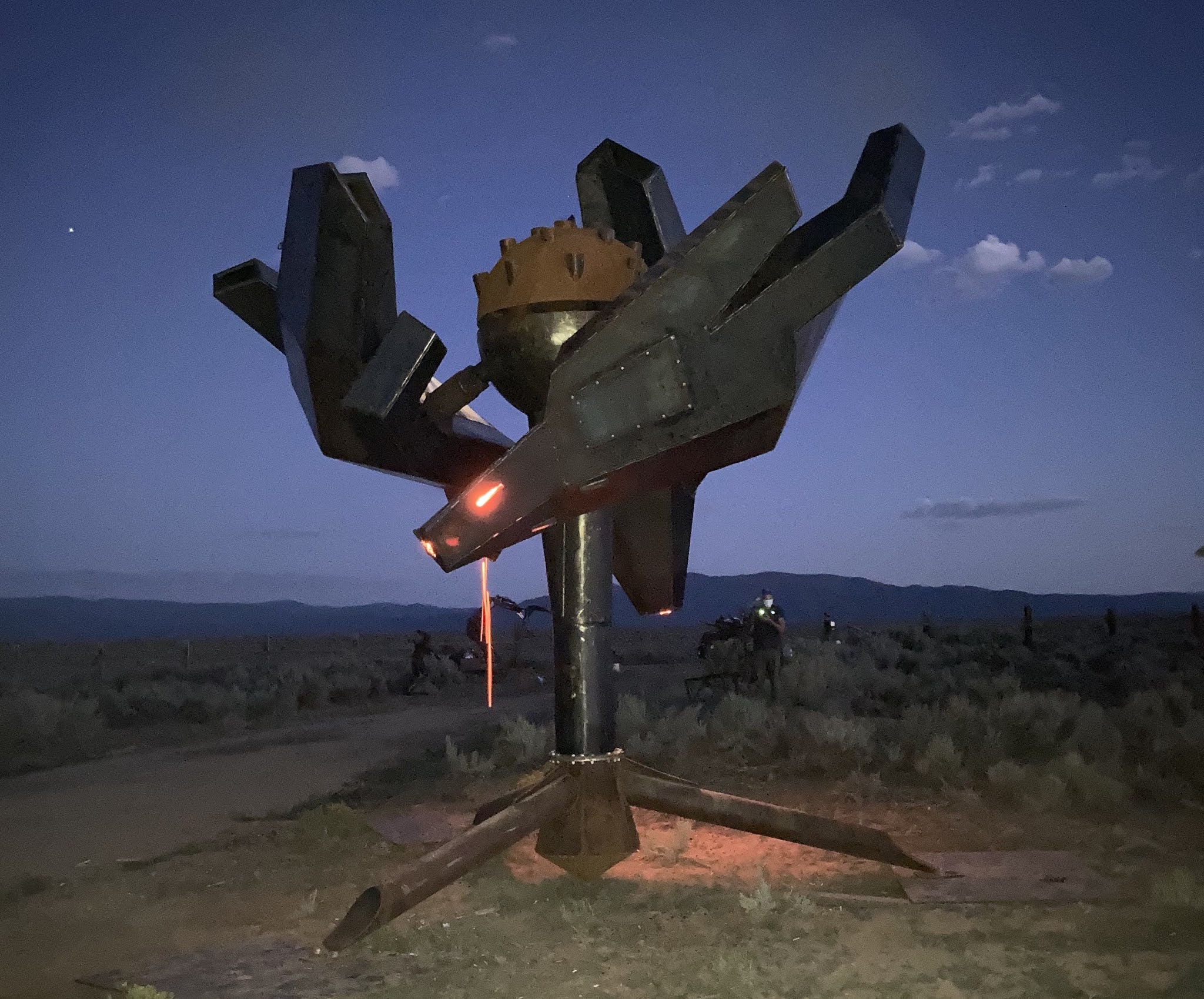
I will dedicate this post to the single topic of Capsule, the new sculpture by Christina and me, which we just installed in Arroyo Seco last week, and then I'll write another post soon on various other ancillary topics.

About a week ago I tried to start this post by writing something like "Christina and I are just a few days away from finishing Capsule, and boy oh boy has it been hard to find time to write." But... haha... that was as far as I got!

Now, a week later, we are finished with Capsule and I do finally have some time.

We had a really incredible social media and internet team backing us up on this, so there is lots of info and pictures online at the Capsule Instagram page and also at the Capsule website.

What I'll try to give here is more of a 'backstage' experience of it.

There were a lot of 'firsts' in this sculpture.
This was the first sculpture Christina and I have built for our local community.
This was the first time we'd built something so fast... on such a short timeline.
And, perhaps most significantly, it was the first time Christina and I had ever worked collaboratively on a piece.

Because of the extremely tight timeline, the idea for the piece came together very fast. So fast, in fact, that when we were able to actually look at the finished sculpture for the first time, a few days ago, we were both genuinely surprised by what we'd built. We both stood back with our mouths half-open and said... "Huh. Interesting." This is also a result of the fact that we build with a very 'old-fashioned' methodology - all 2D drawings and cardboard models - and so we did not have the option to pre-visualize it on a computer.

Using the lathe as a concentric welding fixture

Christina welding inside the sphere

Doing the finish patina on the hands... as they hang on the forklift


The sculpture has two modes: open and closed. It will stay in its closed position for the next few months while it accepts paper notes from visitors. And then, sometime in the fall or winter, we will load it full of firewood and burn all those notes and wood and the burning of all that fuel will cause it to open. This will be the first time the general community gets a chance to see it in the open position, but we did to a test-burn a few nights ago in order to verify the function of the piece, (it mostly worked) and so we have already seen it open.
Capsule Closed


Capsule Open


I must say that I was surprised to see how different the piece looks in its two modes, and how much I like it in the open mode. In the open position the sculpture reminded me of what is probably my favorite abstract sculpture, Spomenik #4. Spomeniks are a group of brutalist non-figurative concrete war monuments in the former Yugoslavia, and although I am no lover of abstract art, the power and appeal of these sculptures is undeniable. 

Spomenik #4 (as titled by photographer Jan Kempenaers) featured on the cover of his great book


Capsule is not technically abstract, as it loosely depicts a fragile globe protected by three hands, but it's probably as close to abstract as I've ever gotten, personally. The unexpected resemblance that I personally perceive between Capsule and Spomenik 4 is a relief, and a point of pride.

It probably should come as no surprise that both Christina and I, being people who have built lots of art which includes ambitious large sculpture, are control freaks. We both have strong visions and we both usually feel committed to seeing those visions actualized... as we see them. Naturally, this makes for some challenges when trying to work together for the first time. I would say that, overall, we did well in this department, and we could do better. As for the interesting question of whether the piece itself is better as a result of its having been the product of two artistic visions smashed into one, or if on the other hand a single unadulterated vision would in general produce a better result... I'm probably not the right one to make that judgment. I do think Christina brought elements to the sculpture that I never would have considered, and vice versa. So I suspect that yes, the piece benefitted. It's like a metaphor for parenting, or for a relationship.

Capsule Artists


We will work with our partners (THANKS CeCe and Matt!!) to determine the right date for the burning reveal of Capsule. It will likely be in the fall or winter and the date will be broadcast all over the Capsule networks, so stay tuned.

As I said at the beginning of this post, I have so much to write about. Capsule was a big part of it, but look for another blog post, hopefully in just a few days, in which I will catch us up on all the other stuff going on, such as 
Camille Paglia
The elusiveness of unstructured thought
My new sculpture prototype
My bookplate, and 
Crickets

Hasta pronto

Thursday, June 18, 2020

Look Out!! Or in...

A few days ago while reading the introduction to a book called "Legendary Artists and the Clothes They Wore" I came across the line "The job of artists is to critique culture, unload their psyches into their work, and make edifying masterpieces the rest of us can revere."

The line feels like a bit of a throwaway... an obligatory expository step on the way to the real meat of the book, but... I couldn't get it out of my head.

The sentence describes three things that artists are supposed to do. The third thing in the list, "mak[ing] edifying masterpieces the rest of us can revere," is really just a catch-all description meant to encompass any work of art which is worthy of our attention. The first two items on the list, however, are what caught my interest.

1) Critique culture.
2) Unload their psyches into their work.

I believe that this is a major distinction which divides the subject matter of art into two subsets: Looking outward and looking inward.

An artwork which critiques culture sets its sights on the world around us. The artist points their gaze outward, away from (him/her)self, and seeks to make a commentary on the society or culture that we all live in. Often this takes the form of some sort of evaluation, or illumination of something the artist feels needs to be examined more closely, and as such this type of art is often part of a cultural dialogue around issues like social change and justice. Artists whose work typically functions in this way include Banksy, Ai Wei Wei, Alice Walker, Taos artist Nikesha Breeze, and my old friend Chris Dacre, among many others. It's also true that every work of art, even those which seek exclusively to critique culture, bears the stamp of its maker, and is therefore personal to some degree.

An artwork which functions primarily as an unloading of the artist's psyche is an artwork that looks inward. This sort of work typically takes topics like emotion, romance, and mortality as its subject matter. These topics might be collected under a subject heading such as 'the fundamental experience of being human,' and might further be classified with terms such as 'psychology' and 'biography.' Artists working in this mode include Egon Schiele, Francis Bacon, Chuck Close, Tim Hawkinson, and Anton Solomoukha. 

These are broad distinctions, and I don't think they encompass all art. For one thing, painting before the advent of photography often functioned simply as a document of noteworthy people and events and this type of painting doesn't really fit into either of the above categories. Also, abstract art (which I usually think of as 'art about art,' and which I generally dislike) also defies these definitions.

And then there are the artists who transcend this distinction, either by crossing over, back and forth, between the two points of view or by defining some interzone between them. This work, I think, has the potential of being particularly powerful. A few artists that come to mind who have managed this feat are Jean-Michel Basquiat, Paul McCarthy, the amazing Marina Abramowic, and perhaps even Ingres. I count these artists as some of my favorites. Incidentally, I believe that film is very well suited to handle this sort of multi-focus crossover; after all, visual art is typically one image while a single film comprises thousands.

My favorite psychology author is the late Alice Miller. Her lifelong focus was child abuse and neglect, and the ways in which the effects of these traumas linger (often unseen) into adulthood. In her book "The Untouched Key" she traces the effects of childhood trauma in public figures such as artists Chaim Soutine and Pablo Picasso, philosopher Friedrich Nietzsche, and dictators Adolph Hitler and Joseph Stalin, showing how abuse and neglect they experienced in their early lives led either to great art or horrible cruelty (depending on critical factors which she does identify). According to her formulations, the work of Soutine and Picasso crossed over between the realms of the inner and the outer, even though the artists themselves were to some degree unaware of the psychological forces at play in their own art. *See below for a bit more about Alice Miller.

But, back to the dichotomy.

I'm guessing that, among the segment of the population which actually gives a shit about art, most people have a preference between art that looks inward and that which looks outward. I do. I prefer to see the psyche of the artist; I prefer work that looks inward.

It's not a strong preference; by no means will I 'write off' art that critiques culture. Some of it is amazing, and amazingly powerful. Banksy routinely makes me chuckle and sometimes makes me think about just how fucked up this world is... in ways that are funnier and more insightful than just reading the news does.

But whereas art that critiques culture is by its very nature 'timely,' dealing with issues that need to be addressed now, inward-looking art is, I believe, more 'timeless.' Questions of what it means to feel love and pain, joy and suffering and loss and death... these are questions which are for everyone, across all time.

So I will take Francis Bacon over Ai Wei Wei any day. 


It must be because I am still trying to understand my own psyche, and I look to other artists for insight and guidance. I trust the sincerity of their curiosity... about themselves. That must be why artist biographies are my favorite genre of books.

Maybe one day I will 'figure myself out,' and maybe I will, at that point, mature into someone who gravitates more to the culturally critical variety of art. It seems like a reasonable possibility. Maybe.


___________________________________

I consider 'music biography,' or books that trace the careers of musicians, to be a genre which is very closely related to 'artist biography.' Among the few books that I've actually finished in the last few years are biographies of Leonardo DaVinci and Francis Bacon, as well as books about Leonard Cohen and Joy Division. In order for me to finish one of these music books, though, it needs to be well written and it needs to be about a musician (or group) that I actually like. 

I recently received in the mail a newly published book about The Sisters of Mercy, a band I like a lot because... you know, I was a teenage goth. And goddamn, is it well written, because... you know, it was written by my brother, Trevor Ristow. 

I've only had the book for about 36 hours and I'm more than half-way through it. 

I have to say... I am really proud of him. 

He self-funded the publishing and was therefore only able to print 200 copies, which sold out immediately. But there is hopefully a second printing coming soon. Click here for more info.

Nice work, Trev!

_____________________________________

*A bit more about Alice Miller: Her most famous book is The Drama of the Gifted Child. It's amazing; I've read it twice. 
The logical conclusion of Miller's views is that the history of art and the history of the world is a document, a legacy, of the childhood treatment experienced by history's main actors. It's a fascinating theory which makes a lot of sense. 
She contends, in The Untouched Key, that Hitler and Stalin were products of neglectful, abusive, and traumatic childhoods, and that, as adults, they turned the terror they had endured as children back onto the world. 
These insights bring a sense of urgency and importance to the upcoming book by Trump's niece, psychologist Mary L. Trump. Ms. Trump's family history apparently describes "a nightmare of traumas and destructive relationships" and promises to “explain how her uncle became the man who now threatens the world’s health, economic security, and social fabric”. I couldn't have said it better myself. Sounds like an important book. Read more about it here.

Monday, June 8, 2020

Bullet Points

I'm calling this post "Bullet Points" because I'm going to try to write leaner, sharper, less indulgently, and perhaps over a wider range of topics.

• • Plus, I like bullet points. • •

• Way back at the beginning of the pandemic, I wrote that I was really enjoying it because we had so much more time. That was wishful thinking. I tried to make myself believe it,.. and yes, we were driving less.. but having your 9-year-old suddenly at home all the time does not create more time. Parents will understand this. Non-parents... maybe not.

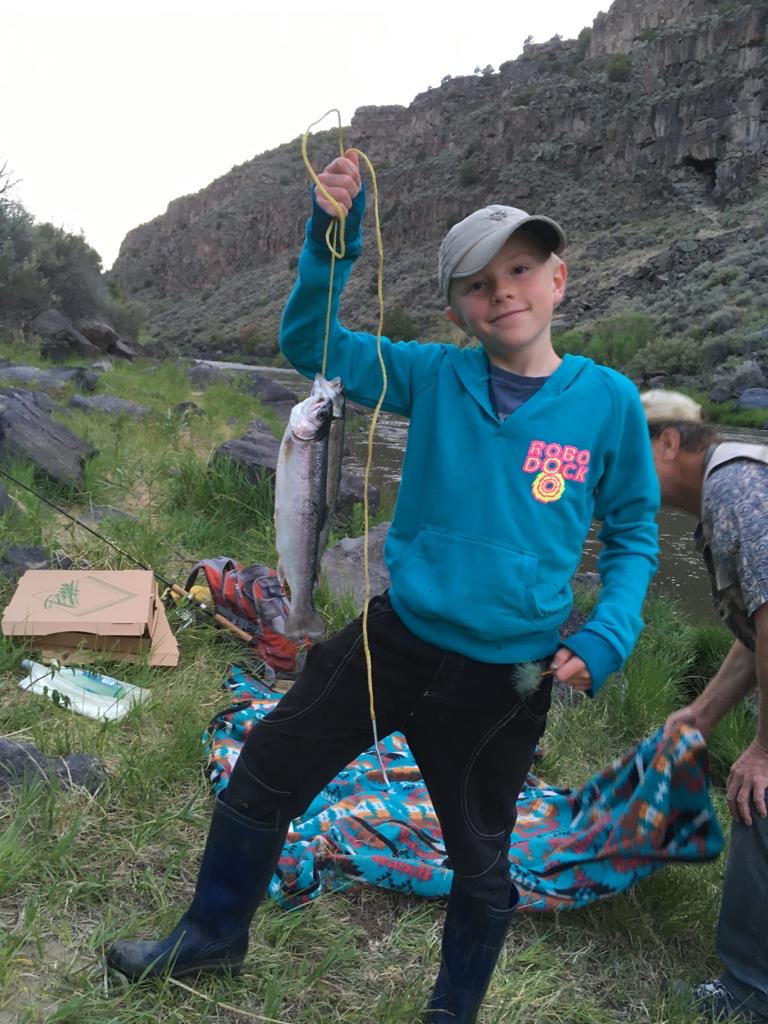
• Christina has handled the home-schooling, and I've been handling the fishing. Kodiak is a fishing maniac, and he's really good at it too. We go down to the Rio Grande a few times a week, and in the time since we started fishing he has caught 24 fish while I have caught 4. We eat a lot of trout. 


• I was recently reading about Rainer Maria Rilke and apparently he suffered an artistic crisis which caused him to take a whole decade to finish a certain book. This made me feel more OK about my little artistic crisis. I'm trying to be a little less hard on myself.

• Christina and I recently got a commission to build a new sculpture for the little town of Arroyo Seco, just north of Taos. It's gratifying to get a cool new job like that, during this pandemic/lockdown/COVIDcrisis. We have to bang out the sculpture in about 6 weeks, and... we are working together... actually collaborating... for the first time ever! The sculpture is called Capsule and you can keep up with it here and here.

• 2019 was a bit of a tough year for Christina and me, as a couple. 2020 is shaping up to be a lot better. It's not something I write about so much on my blog, but Christina is an amazing woman and I am lucky to have her in my life. I love you, Sporrong!

• I've written before on this blog about the psychological component of the divide between right and left, and I continue to be fascinated by it. In my last post I said I had an observation to make about politics, and it's this: Conservatives seem to need certainties, while progressives seem to be more comfortable with uncertainties. Trump and his supporters seize on any new possible treatment for COVID19, declaring it the 'wonder-cure' before the scientific results are even in. Remember Hydroxychloroquine? Liberals seem OK with actually waiting until there is a proven therapy, understanding that these things take time. Conservatives are drawn to religion in part, I think, because it offers a story that answers the difficult questions, while liberals understand that these questions might just not be answerable... and they are OK with that. And it's cross-cultural; conservative westerners hold onto Christianity, conservative middle-easterners flock to Islam, and conservative Jews are pretty into Judaism. Trump blames China for COVID, while conservative Iran blames the USA and Israel. How does this help anything? I'll tell you how it helps: it helps them feel better, having someone to blame. My guess is that it's related to the enlarged amygdala in the conservative brain and the interrelated way in which their worldview is oriented around fear. Life is disorderly, but the conservative impulse is to stamp out the disorder with 'law and order,' stamp out the fear with certainty. Conservatives need certainty. It's comedy.

• I've mentioned before that I collect original paintings from the 1970's cartoon series Wicked Wanda, but those are just one part of a modest art collection that I add to when I can. I just acquired this quartet of drawings from Allison Reimold.


• I've recently come up with a new idea for a large-scale mechanical sculpture, and it's quite interesting to note how inspired I feel by the challenge of building complicated big machines. I'm already beginning to work on a small prototype of it... you know, in my spare time!

• As part of the process of working on Capsule, Christina and I have busted out the clay to work out some of the forms, and that has inspired me to work on another clay sculpture... another portrait / bust. I also picked up some really sculpturally-interesting tree-parts the last time I was at the lumber yard, which are inspiring me to build another human-scale piece like Big Mother. Sometimes it seems like the biggest challenge for me is WHERE to focus the creative energy... big sculptures, or small prototypes, or human-scale tree-sculptures, or paintings, or clay portraits? Hell, I'm a frickin' Renaissance-man. Or at least I would be if I had the time. 

• For now... Capsule. Stay tuned. 


Spring time in Taos is motorcycle season.
(The white tube is for fishing rods!)


And it's beautiful.