Tuesday, June 27, 2017

Moving things along

Ok wow, so much has happened since the last time I wrote. In this case, life has just been happening so fast that there hasn't really been time to chronicle it, but I'm going to try to squeeze in a post. I think it will slip largely into travelogue mode because like I said, lots going on.

Do I remember correctly that high school and college essays are supposed to begin with a paragraph laying out everything that is to follow.. an outline... a sort of pre-summary? OK, well we went to Berlin to show the Hand of Man, and Berlin was awesome. We returned to Barcelona in time to catch the Barcelona Maker Faire, after which we spent a sweet couple of days in Cadaqués, on the Costa Brava. There was some art sprinkled in there, and plenty of reckoning about what the second half of our time here in Europe might look like.

After all that hassle negotiating the transport of the Hand over to Europe, it finally really did arrive in Berlin. Although local conditions precluded us from smashing cars, we still managed to annoy the venue folks with the Hand's steady drip drip drip of hydraulic oil onto the pavement. Germans don't seem to have a lot of love for drippy hydro systems, but everyone was happy after we fixed it. The Hand was the main advertising image for the Faire, and damn... that image was everywhere in Berlin! It was very cool to see it on every corner in town.


After we packed it all up for shipment back to Barcelona, we had a few days vacation in Berlin. Personally speaking, the charm of Berlin sort of snuck up on me. It's not a great beauty like Prague or Venice or even Barcelona. The architecture is quite boring and in some cases oppressive. There are no Mediterranean beaches or mountains in the distance; in fact the entire city is quite flat. Also, parts of it are a huge construction zone.


But... the city is spectacularly green, with a super-high percentage of area devoted to park (numbers are a bit hard to pin down, but Wikipedia calls it at about 33% of the city, while Barcelona lags behind at 10%), which people really seem to use. And the river Spree, which snakes through it, is wide and beautiful and you can go boating on it. I understand there are even some beaches in Berlin, although I'm not sure if they are on the Spree or on one or another of the city's lakes. The playgrounds are plentiful and the most imaginative I've ever seen. And there is no lack of monuments (mostly about the war). But more than all that, Berlin is full of art and artists and people who seem to really love living there. Time and again we heard people tell us that the cost-of-living to quality-of-life ratio there is better than anywhere else in Europe. And sure enough.. a bit of searching online shows flats for rent in Berlin comparable to ours in Barcelona coming in at 50-70% of the cost, with garden access to boot. Plus, artists in Berlin seem to actually have workshops, in which they seem to actually work! We even know a few of them already!


Sculpture by Keith Haring


Sculptures by Wilfried Fitzenreiter
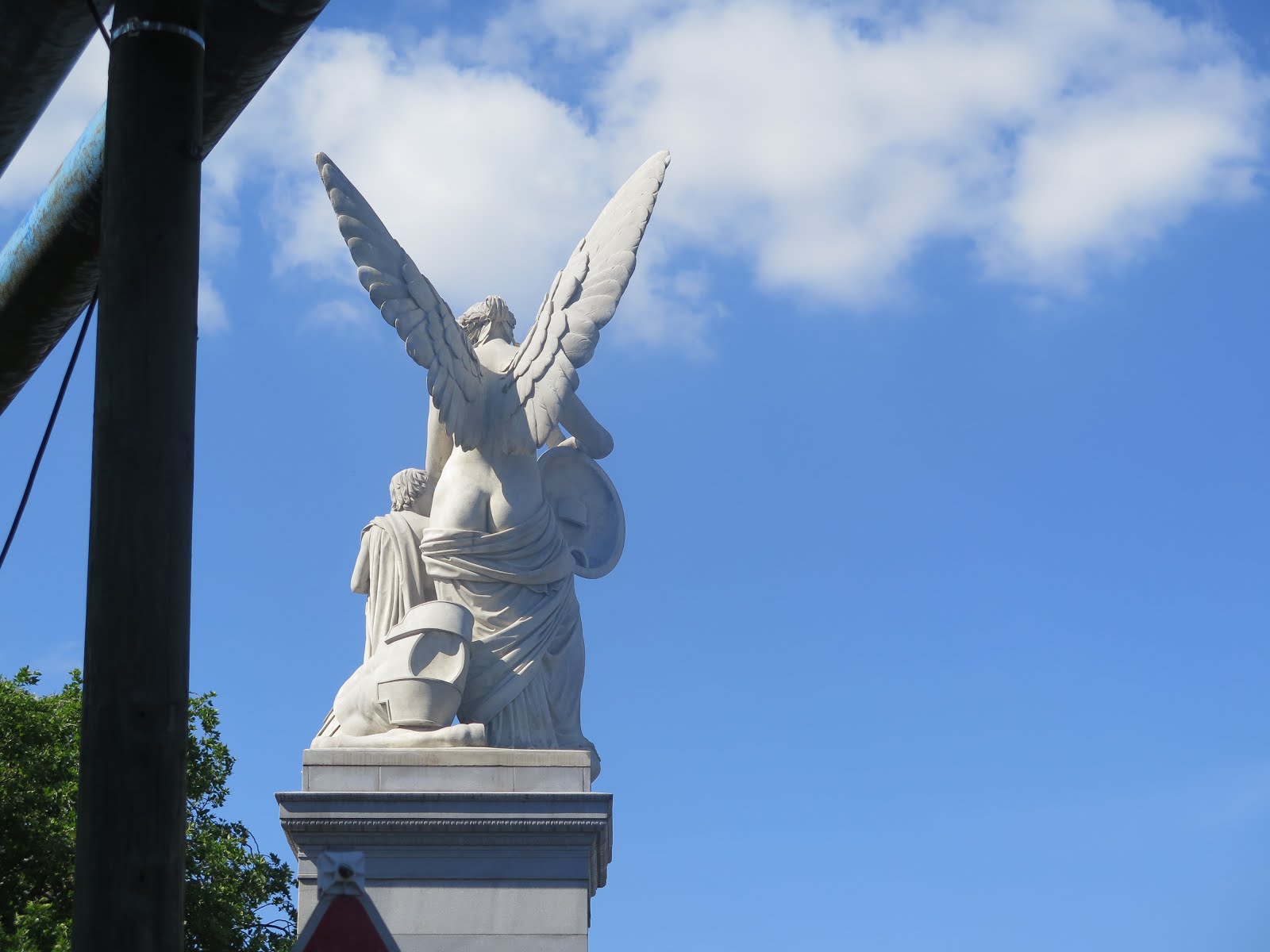


Sculpture by Eduardo Chillida


Watercolor by Anne Bengard


So, unsurprisingly, we are starting to think about what it might look like to spend the second half of our time here in Europe over there in Berlin. The challenges would be huge, the bureaucracy burden is apparently even worse than in Spain (hard to believe) and at this point it's not at all clear if it would be worth the trouble. But we are thinking about it. Ironically Christina and I would trade places in some sense, insofar as she speaks German and I don't. It would be an interesting shift!

Well just in case we hadn't gotten our fill of laser cutters, 3D printers, and LEDs in Germany, we landed in Barcelona just in time for Maker Faire (for which I'd tried hard to arrange a showing of the Hand, but I was a bit too late to successfully navigate the requirements of the venue). Catching up with old friend Sabrina Merlo was definitely a highlight.


After that we tagged along with Sabrina and her kids Ruby and Arlo to a great little sublet in Salvador Dali's old beach town of Cadaqués for a few days. What a tough life we lead!


We returned from the coast in time for me to catch the second half of my final sculpture class of the course (after having sadly missed quite a few because of our travels). Here are another few pix of the male portrait. Again, this is after only 3 sessions, while the other students in my class worked on this one for 6 sessions. I'm frankly not sure when I will ever have time to finish it, which is a shame.


In the last few days we've done some memorable things, such as wander around the city during Día de Sant Joan which is widely, and I think correctly, billed as the single craziest day of the year in Barcelona. There are bonfires in the streets and everyone is throwing fireworks everywhere, regardless of whether or not people are nearby. Seriously. And police are nowhere to be seen. Somehow people do not seem to die en masse. Somehow it all seems to work.


Later that night we joined Grey and Nova and a hundred other people for a clandestine midnight marching band escapade at the end of a pier jutting out into the Mediterranean, complete with "firework twirling" courtesy of Christina. Highly memorable.


And most recently we saw "Björk Digital" at the CCCB. I'm a big fan of Björk; I had high expectations and I wasn't disappointed. Well, not grossly disappointed anyway. The show featured 6 new works by her which are essentially music videos from her newest album Vulnicura. But instead of regular videos, one is an immersive 2-screen experience and the remaining five are VR pieces. Personally I think Björk is a genius for her vision and her embrace of new technologies in the service of reaching people in new ways, and the show flaunted these strengths well. In retrospect (and through conversation with Sabrina) I do feel that the VR pieces did not perhaps take sufficient advantage of the possibilities of the platform, in the sense that there was no real interactivity. My experience in Venice with Paul McCarthy's VR piece sheds an illuminating light on this; while the characters in his VR followed me around and made me feel implicated in the narrative, with Björk's pieces I simply felt like a bystander watching her and her avatars go through various therapeutic and gymnastic maneuvers and transformations. Granted, the visuals were spectacular and the experience was great, but... maybe it could have been greater. Let's not forget that the medium is still in its infancy.


After the VR pieces was a video explaining her 2011 project "Biophilia." I use the term project because Biophilia was an album and an interrelated app which attempted to invent a whole new way of music-making, separate from sheet music. I won't get too into it here because it would take too long. But I have nothing but admiration for this kind of big vision. And Björk has it. The Biophilia app has been adopted into schools in several Scandinavian countries as part of their music programs. Christina downloaded the app and she and Kodiak have begun to make music. Initial reports from the family are positive. 

This brings me back to a theme which is starting to recur here, which is the concept of authorship. Let's recall that Damien Hirst is regularly lampooned for his lack of hands-on involvement in the fabrication of his work. But would any of us imagine that Björk is writing the code for Biophilia or her VR pieces? Or that Paul McCarthy writes code? Of course not... they need specialists to help them realize these big visions, although it seems almost certain that they are intimately involved in an artistic direction sort of capacity. Why would we imagine that Hirst isn't also involved in this way? Also, Björk is very vocal about sharing credit with her main collaborators, while Hirst hides them away in anonymity. Is Hirst a target because he's a visual artist, making objects, selling them, and getting rich? Certainly McCarthy is not so different. I had a recent discussion about a "Miró rug," which is to say a rug featuring a design by Miró. Certainly he did not weave it personally and certainly he benefitted financially and/or career-wise from the rug, but was he subject to the same withering criticism regularly leveled at Hirst? Maybe Hirst is criticized because he outsources his work on such a grand scale, or because he's smug, or rich. Who knows. What I can say is that there's a continuum, and it's not just along a single parameter. In my estimation, the variables at play here (among others) are the scale of the outsourcing, the degree to which credit is publicly shared, the public perception of the ego of the artist, and the amount of money changing hands. With these variables plotted on an imaginary graph, it's not hard to see why Björk is perceived in a generally more favorable light by the public than Hirst. But another thing I can unequivocally say is that big ambitious work takes vision, boldness, money, and a team, and I have a ton of admiration for anyone pulling off work on this scale. 

Well, now we settle into the summer. No school for Kodiak, lots of tourists, and HOT HOT HOT. 


Hasta la vista, baby.


Saturday, June 3, 2017

Time to Work

Sometimes I publish a blog post only to find in the ensuing days that the ideas expressed therein were not complete, or have been leading on to other ideas. Such is the case with the last one or two posts. It's like I am having a conversation with myself (which we all do, all the time, don't we?) and writing it all down in this blog, hoping, in the way that all writers do I guess, that the act of writing it will make it more real, or maybe even reach someone.

As I said in the Venice post, reactions to art are highly personal. I think that in much the same way as our underlying psychologies inform our choices of mate and our political leanings, that same underlying psychology probably has much to do with what art / media we respond to. What follows is a snapshot of the current state of my thoughts about art, subject to change without prior notice from the management.

I personally am a person who is not particularly in touch with my emotional side. I am ruled by my intellect to the degree that basic core emotions are often parsed and intellectualized by some pre-conscious editor before even rising to the level of conscious experience. As such, I'm often only dimly aware that an emotion "happened," and figuring out what I actually feel, as opposed to think, can seem like detective work.

It seems too far fetched to imagine that this psychological underlayment would not be related to the fact that, for me, art which inspires an emotional reaction is the holy grail. Any piece of art which can jerk me out of the rational, which can pierce that controlled intellectual narrative, can actually affect me, is something I like and something I remember. By extension, I imagine that those who are ruled by their emotional side might well be attracted to art and media that presents a more intellectual experience, but this is only a guess.

For me, music is the art form which most consistently elicits this kind of reaction (barring movies of course, which A) can yank your emotions around like nothing else, and B) I just don't watch that much). Maybe it's a song I haven't heard in years that I used to love, maybe it's a soaring orchestral part, maybe it's a movingly personal lyric. In my experience, the visual arts have a much harder time managing this, yet that's where my interests lie.

I believe that getting the heart racing through fear or through a thrilling experience hits the same target of jerking you out of the rational, and this is why motorcycle riding, roller coasters, and robot performances can be so fun. But fear / thrill is also probably the easiest reaction to elicit, at least among positive reactions (disgust or anger might be easier to foster, but you're likely going into debased territory if you're aiming for those). How do you tease out those subtler emotions, like sadness, joy, reverie, transcendence, or ecstasy? There are no clear answers here; this is the challenge of making this kind of work.

There's a quote I like very much from an article Amanda Palmer wrote about Nick Cave for the Guardian. I go back and read it every few months...
"But fundamentally this is what we – as artists – have always done. We take our pain and we transform it into some kind of narrative, some show or story, something … else. We frame our trauma as best we can, and we offer it up. At best, it’s a gift; at worst, it’s a product. And the amount of enduring respect we bestow on our artists seems to be directly proportionate to how well, how authentically, how selflessly, they can take and deliver an emotional selfie like this."

Does Damien Hirst fit into this at all? Or Jassans? Well, if we use "jerking you out of the rational" as the target, there are lots of ways to get there. I think that work which inspires thoughts about larger, deeper issues which by their nature defy easy intellectualization, such as love, beauty, mortality, loss, and similar concepts is capable of inspiring similar reactions to that which brings out a purely emotional response. And beauty itself, when it is undeniable... when it hits you hard because it stands apart so clearly from everything around it... can bring you there too.

These observations go some way towards describing why I have no love for abstract art, or art about art. Mondrian or Jackson Pollock might be interesting when viewed from within the framework of the flow of art history, but they don't say anything and don't seem to mean anything, at least not to me. Maybe one day I will think differently.


These are all from Niccolo dell'Arca's amazing Compianto Sul Cristo Morto


Two of my favorite Francis Bacon images

Last weekend I met a fellow artist through a play-date for Kodiak. He'd taken a 10-year hiatus from art-making, but recently come back to it with a new sense of purpose, one example of which is a commitment to finish a new piece every week (he's working with media in which that is a more feasible proposal than it would be in sculpture). I was inspired by this meeting to try increase my focus and increase my production. As such I spent four out of five days this week sculpting, either at class or at home.


These are pictures of my full-figure piece at class. These show the more-or-less finished result; she is actually a bit advanced now from when these pictures were taken, but the changes are slight.


 This is the portrait I just started. For reference, I've got about 6-7 hours into this one by now.


This is the plasticene (non-hardening, oil-based clay) piece I've been working on at home. It sat for quite a few weeks recently with no work done, but I'm newly motivated to finish it. The boobs need to get a bit smaller, she needs ears and hair, and a few other things, but I'm pretty happy with her. I've decided to mold and cast her, because... why not. Otherwise plasticene sculptures are destined for the trash-bin, sooner or later... they don't hold up. I continue to find the pose and expression quite compelling. 


Here is something I built from cardboard, hot glue, syringes, rubber tubing, and wood bits. It's a mask with kinetic elements, operated by simple syringe-based water hydraulics. The glove means I can make it operate wherever, whenever, while walking around. It still needs a bit of surface treatment, as in finishing the paint job and maybe some tiki-style design work on the face. Here is a 20-second video.


I keep saying that I am going to talk about the passage of time, and the perception of it. I'll keep it quick and get to the point. As an adult, I feel that time moves so fast, and I have very little sense of it. Memory isn't what it used to be, and so much of daily life is unremarkable and not really worthy of logging in to the memory banks anyway. What did I eat for dinner 2 nights ago? Or even last night? Who knows. One needs landmarks to understand the passage of time, and for me the important landmarks are the milestones of Kodiak's life (which will happen on their own), and my own work (which I need to be focused on in order to make happen). This sense of time flying by is just another reason to kick myself in the ass and get to work. One neat thing about sculpture is that it will continue to exist even after I no longer exist. But only if I make it.

Wednesday, May 31, 2017

Oh boy, there's always so much to write about; it's dangerous to let too much time pass between posts. I can already tell that this post will be a bit sprawling, a bit all-over-the-place.

I'll start with Wylie and Trevor's questions, before they get away from me.

1) Wylie Elson asked me not long ago: "Why all the fuss about getting a studio? Why don't you just rent one?" The short answer is: money. We are on a fixed income, we can't legally work in Spain yet, and we ended up in a slightly expensive apartment in the Raval. There's not enough left over to rent a studio, never mind to start buying tools over here to outfit it with.

But the story gets more complicated and interesting, because it's almost certain that we will be leaving this apartment soon for various reasons. The #1 reason is that it's too expensive. The other #1 reason (tied for first place) is that Christina can not stand the Raval anymore (see Urban Filter below). She is dying to get out of this neighborhood (which will be a minor tragedy for me) and into a more tranquilo barrio, such as Gracia or Sants or somewhere near Montjuic. This adds another interlocked layer to the answer to Wylie's question, which is that because we don't really know where we will be living, and we want our workspace to be close to our flat, it's premature to rent a space. One of the big goals of our upcoming move is to lower our rent, so we will likely be able to carve off a bit of that fixed income in order to rent a studio.

This topic of getting a workspace also involves a cautionary tale about the dangers of expectations, and how they so often lead to disappointment. In the early months of this blog I talked quite a bit about our search for a workspace here in Barcelona. You might recall that this involved many visits to many different "collective" or "communal" workspaces. When we arrived in Spain and started talking to people about needing workspace, we were inundated with suggestions of specific "art-spaces" which worked on a collective level, and we were immediately seduced by the fantasy of big communal spaces with shared tools, as in the Bay Area's Crucible or American Steel, or even better yet, Tech Shop. Well, yes... it was a fantasy. It turns out there is no Tech Shop or Crucible or American Steel here, or anything even remotely like them. Yes, there are collective art spaces, but sculptors are not welcome due to "dust and noise" and of course there are no tools. We did find some halfway decent metal shops, but they are private. Shared metal-working tools in Barcelona? Ha ha, no sir. All of this took about 2 months to discover, which it to say it took two months for our fantasies and expectations to crash and burn.

The shipping container which lands in Berlin in 10 days which contains the Hand of Man also contains the rudimentary basics of a metal-working shop, so... fingers crossed that we can carve off some money and rent a space, once we find our new digs.

2) After reading my brief discussion of the Catalan independence movement, my brother Trevor asked about my personal stance on the matter. The short answer is: I don't believe I'm qualified to say. It's an immensely complicated topic, steeped in history and all the resentments that history and power engender, and I'm an American guy who has been here for 6 months. Also, I find that discussing politics is a quagmire I am almost always reluctant to enter, as there is always someone who will disagree with your position, opinions are almost never changed, and arguments (in addition to being frequent) are usually won by the more passionate and vociferous combatant, regardless of content.

Now, that being said, I can cautiously offer an opinion which may well change at any time in the future, pending new information, and which might piss off a reader or two (hey, don't be so sensitive! I'm an American guy who moved here six months ago!)

It seems to me that Cataluña would be better off remaining part of Spain, BUT... I think that if Madrid (which is to say the Spanish federal government) were to treat Cataluña more fairly, Catalans would be less prone to holding symbolic secession votes and being pissed off in general. I am familiar with only a very few examples of this unfair treatment, but here goes... (I'm sure that interested parties could read on this topic ad nauseum with a bit of Googling)

Cataluña is the most prosperous and industrialized region of Spain. My understanding is that it provides the highest per-capita flow of tax income to the federal government, and some even call it the economic engine of Spain. Apparently the only highways in Spain which collect tolls are in Cataluña, so Catalans are the only ones paying tolls in Spain, and yet the money all goes to Madrid. My understanding is that this is just one example of this sort of thing, and I think this kind of "special" treatment engenders resentment.

After the death of Franco, Madrid granted increasing autonomy to Cataluña, including the right to bring back the Catalan language which is now used in schools, government, and everywhere in between. That was a step in the right direction, and I believe that if Madrid would treat Catalans like the proud and accomplished people that they are, and stop taking advantage of them to subsidize the rest of the country, the people of Cataluña would be less inclined to splinter off. Cataluña, as an independent nation, would be extremely small and would lose the foreign relations and military resources (as well as others) afforded by being part of Spain.

Just my opinion.

• The Urban Filter is nothing more than a name I have devised for whatever psychological mechanism I have in place which allows me to selectively filter out negative experiences in the urban environment. Christina doesn't have this filter, or at least hers is less well developed; hence her difficulties with the dense and bizarre neighborhood we live in.

I talked a few months ago about how some people need to shield themselves from the onslaught of human energy in urban spaces with the use of things like sunglasses, headphones, and hoodies. I have found that I personally do not need these devices; I have a built-in protection device, an urban filter, which allows me to look past the homeless and the junkies and the groups of tourists. I can actually adjust my filter on the fly and choose to essentially ignore people altogether if it suits my mood.

On our recent trip to Venice we had a conversation on this topic with our friends Jamie Henthorn and Ash, discovering in the process that one of them (Jamie) was more discerning/oblivious like me, and the other (Ash) was more like Christina. Jamie provided the insight that Ash is simply in possession of (or afflicted by) a developed empathy instinct which made her feel all the pain of all the damaged people in the city, thereby transforming a walk down a city street into a harrowing experience. This insight suddenly put Christina's difficulties in the Raval into a new light.

She feels the pain of the city's broken people; I don't.
I can filter all of that out and soak up the energy of the city (which, if I am honest about it, really means soaking up the energy of the people... primarily the happy, the young, the lovers, the ones who are present and engaged.) 

Ironically, I have come to love the Raval. Sometimes I leave my sculpture class late in the evening, and I ride my bike up through the Rambla de Raval. That ride, in the twilight, through the laughing people and the crying people and the street markets and the trees and the cars and bikes and tourists is magic. It sounds corny but it's like the tapestry of humanity is laid out before you and all you have to do is move through it. You are a part of it.

• Damien Hirst / Italy. Our trip to Venice continues to reverberate for me. In retrospect it was a great trip and it was much more than a great trip; I find myself thinking often about Venice and about the art we saw there, especially Damien Hirst's work.

To be honest I am struggling with my newfound interest in Hirst; he is a distasteful character in so many ways and yet a compelling and fascinating one. Like so much in life there are reasons to like him and reasons to dislike him, but what might be a bigger tribute to him than my thoughts about any individual artwork is the fact that my feelings about him are elevated past like and dislike to something like love and hate.

I think that his approach to art is, in the end, as much a part of what makes him interesting as the art itself. It should be noted that certain elements of his approach, such as his use of paid craftsmen to execute the work, have certainly not been pioneered by him (Jeff Koons comes to mind, but I despise Koons' work so thoroughly that I can't be bothered to learn enough about him to use him as a case study). As stated in the last post, as a craftsman I have a hard time with this one while simultaneously admiring it. Hirst himself makes the case that he is no different in this regard than an architect, who of course brings the idea and design but does none of the execution, and subsequently receives the credit and fame (typically without any controversy). It occurs to me that movie directors almost fall into the same category.

This topic has caused me to tentatively begin to investigate my own relationship to craftsmanship and authorship. What would it be like, I wonder, to put out into the world an artwork which I had directed, as if in the role of an architect, but which I had had no role in fabricating? Conversely, what are the benefits of actually being the craftsman? How, if at all, do these relationships change if an artist gets partial help in constructing a piece? (When I constructed the Subjugator in 1996 I did all the work myself, with the exception of the radio-control interface board, which was designed and built by my friend Mike Fogarty. I have always been quick to give credit where credit was due... but what if that RC board was a store-bought product instead of something made by a friend? Surely in that case I would feel no need to mention it. Does any of this diminish my "authorship" of the Subjugator?) I do gain important rewards from constructing my own work, such as a sense of pride and a sense of accomplishment. And each newly constructed work adds to my knowledge base in such a way as to enable further "reach" in future pieces. I have become a walking database of technical knowledge, and I wonder if someone in Hirst's position feels that way... or has any regrets about the degree to which he does not feel that way. On the other hand, as I mentioned in my last post... imagine how much work one could "make" if thinking up the concept was the only job. Making good work takes time, and this of course slows down the process. Ideas come faster than work can be made, usually. A common criticism leveled at Hirst is that it's harder to fabricate good work than it is to think of the idea. I'm not so sure I agree. Art succeeds or fails on it's underlying idea, and coming up with an idea that can stand the test of time is no small task. Hirst of course has the funds available to make those ideas into substance, which differentiates him from most of us who have good ideas which never go anywhere. 

Another way in which Hirst secures the mantle of "controversial" is his apparently voracious appetite for stealing other people's ideas for his own work. This is something I am less ambivalent about, but even still I see many sides of the issue. Ironically, I have previously within this blog stated that I very much liked the book "Steal Like An Artist" by Austin Kleon. Kleon makes the point that everyone steals, and it's a valuable technique for getting into the practice of art-making, but his ultimate message is more about using appropriation as a way to find a path to your own unique voice. I do not yet have enough knowledge about the trajectory of Hirst's career to understand if he did just this, although initial readings of his propensity for appropriation over quite a long span of time do suggest that he has less qualms about nabbing other people's ideas than what might be considered "normal." My take on the page linked above is that Hirst's standard MO is to re-work a piece just past the 10% threshold for avoiding copyright infringement (which turns out to be a myth anyway) and then give it a much better name, often involving cosmic or cryptic language. And although it's hard to see this as anything other than despicable, maybe it's more complicated than that. In leveraging his fame and his name, hasn't Hirst brought an artistically valuable idea into much broader view than it otherwise would have been? Hasn't he also in fact elevated the name and the fame of the artist from whom he "borrowed?" The fact that he does it all in the service of his own financial gain and aggrandizement certainly falls on the "despicable" side of the spectrum, but I doubt there's any way he could "give credit where credit is due" and come out undamaged. It's certainly a clear demonstration of the power of a name.

In contrast to Koons, about whose work I couldn't care less, Hirst's work variously inspires in me love as well as hate, or at least indifference. To me, his "Spot Paintings" are horrible. 


Not so much because they are horrible paintings, but because they are both stupid / pointless AND pawned off as some sort of genius by dint of the fact that they came from Hirst himself (who, unsurprisingly, paints almost none of them). It's as if he was experiencing a lull in his flow of ideas but felt he needed to keep putting out work, and devised these paintings to fill the gap, almost daring anyone to call them out for the crap that they are. In fact I think these constitute a sort of "abuse of power." I feel similar derision for the "Spin Paintings."

On the other hand, I find most of his work which touches on death to be fairly compelling. I think works such as "A Thousand Years" and "Mother and Child Divided" are at least thought-provoking (which is actually saying something) if not actually great. Apparently Francis Bacon, who I LOVE LOVE LOVE, had a strongly positive reaction to A Thousand Years.

As I discussed at length in my last post, I very much liked Hirst's work on display in Venice. But my favorite works of his right now are those which blend beauty and death, such as his "portrait" of Kate Moss


And even more so the sculptures "Virgin Mother"


and "Anatomy of an Angel"


I love these pieces for the impact they deliver, the messages about the power of beauty and also its frailty and ephemeral nature, the presence of musculature and blood (and by extension, death) which is ever-present beneath the skin, and in the case of the last one, the secular message of exposing the human anatomy of an angel. It's as if he found a way to "hide" an anti-religious sentiment in a sculpture which, by its form and material, otherwise does a pretty good job as coming off as religious. 

Clearly, I'm currently intrigued by Hirst. Another reverberation of our trip to Venice is a current interest in Italy itself. I don't have so much to say about that, other than that I am hoping to be able to operate the Hand of Man for Maker Faire in Rome in December (there is currently no actual reason to be optimistic about this... it's just something I hope I can arrange), and hoping to take a two-week marble sculpting workshop in Carrara (home of the world's most famous quarries of white marble) in August. That is something which I quite likely will actually be able to do, and boy am I excited at the prospect. 
Also, everyone should listen to Laibach's re-working of the Italian National Anthem from their amazing album Volk. (European readers might need to use a VPN to get that video to load)

I promise to do another post soon, with photos of my ongoing sculpture work. The photos are actually ready to show, but it doesn't seem right to bury them at the bottom of this sprawling post. Soon, I promise.

OK, lastly, am I the only one to notice the similarity between Javier Bardem's character in the new Pirates of the Caribbean movie and Till Lindemann?


¡Hasta pronto!