Tuesday, July 13, 2021
Vanagons (and drawings of Naked Ladies!)
Tuesday, April 6, 2021
Painting, Prada, and Flowers
Wow, it's been 9 weeks or so since I posted.
That's a long time for me and this blog.
Let me start by saying that I was recently interviewed for a podcast called 'Art Robot Death.' I believe it is actually a pretty good interview. You can find it HERE.
I finally finished the interpretation of Ingres' Jupiter and Thetis, the painting I call 'Juniper and Cletus.' (Or should it be 'Juniper and Themis'? 'Themis' is closer to 'Thetis,' but Themis is a sort of arcane name here in the US, plus it's my brother's name and I'm definitely not trying to implicate him in this painting. 'Cletus,' on the other hand, is an almost comically redneck name and very American. I can't decide which is better.)
Here's the painting:
I'm pleased with it. Her face could've turned out better, but after coming and going from this painting for over a year, boy-oh-boy was I done. So I called it done.
I've started another painting, which is sort of an important one in the extremely short 'history' of my painting career. The reason I say this is that this painting, the one I've just begun, is the image which appeared to me - as if in a vision - back in Berlin and it's the image that caused me to consider beginning to paint in the first place. I've been working on the image in photoshop, off and on, for a few years now. I finally got the image to a point that I liked, AND my skills are now barely sufficient to pull it off, so I decided to go for it. I will update the blog some time soon with some images.
I am personally having a hard time with a certain aspect of the gradual end of the COVID era, and that is the prospect of being social again. During COVID it has been perfectly acceptable to be a hermit, and I have frankly enjoyed that. I'm probably not alone in these sentiments. Avoiding social gatherings is not the answer either, though; introverts like me need to push through the discomfort. So please keep inviting Christina and me to stuff, you few who do. (That's pretty good.... "you few who do")
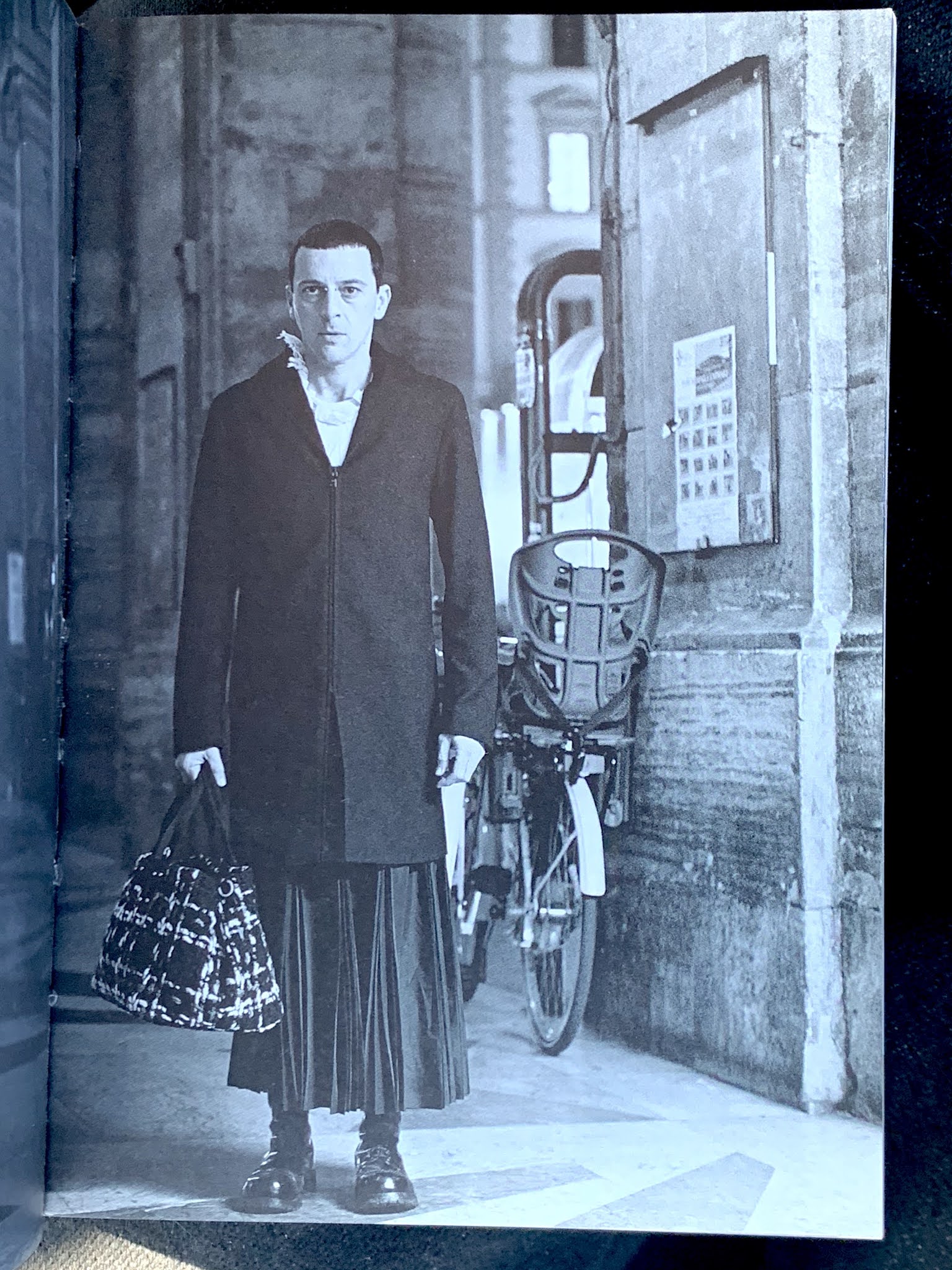
I find that I am having an increased interest in the psychology of clothing. Way back in May, 2018, I wrote a blog post that touched on this; I wrote that clothing was a filter which acted to sift through the people we encounter and only let through those who could understand, or were not intimidated by the fashion filter. I believe that my current interest has been spurred by the fact that I am currently strongly drawn to a certain type of outerwear, which has a certain quality to it; namely that it is constructed of fabric which maintains a certain rigidity and does not wrinkle easily. Here are three examples:
I don't know much about the first two examples other than to say they are images from a book called 'The Sartorialist - Closer' by Scott Schuman. The third example is an image of Amanda Gorman at Biden's inauguration, wearing a Prada coat. I have come to the belief that Prada has a sensitivity for fabrics which act this way. (I'm currently coveting a particular Prada coat which I can't really afford, but I'm selling shit on eBay).
This may all seem trivial to you, my reader, and it probably is. But I bring it up because I am curious about what it says about me and my psychology. I think the simplicity and rigidity of this type of clothing feels like a sort of 'armor' for me. (A few years ago, for a time, I was seriously considering building myself a suit of armor.) But rarely does something mean only one thing; I believe there are also other ways in which this type of garment reflects something I see in myself, or want to see in myself.
I believe this is a rich and fascinating field of inquiry. Stop to think, just for a minute, about what your clothing says to the world about you. How does your clothing change from day to day, and over longer periods of time? What are the different social messages being sent by the guy in shorts, flip flops, and a Hawaiian shirt; or the guy in the business suit; or the guy in the ripped black jeans, the leather jacket and boots, and the nose ring? In any case, I've recently purchased a college textbook called "The Social Psychology of Dress" (with chapters such as 'The Origins and Functions of Dress," "Dress and Impression Formation," and "Dress and Social Groups") which promises to dive deeply into these questions of fashion and psychology. I'm very interested to read it.
I was recently commissioned to build a shade structure for Meow Wolf in Santa Fe. The request stipulated that the shade structure would be situated just next to Becoming Human, and would tie together with the sculpture somehow. I came up with an idea, but Christina had a much better idea, so I'm building that. It will be the flower patch from which the big guy picked his flower. So... I've been back in the shop doing metal fabrication for the last few weeks. Pictures to come.
That's it for now.
Keep being creative, everybody.
Sunday, January 31, 2021
Fuck the Orthodoxy!
A few of these 'rules,' for example, are:
• Start by painting the large forms, and when the large forms of color and value are in place, then you can get smaller and more detailed.
• It's a mistake to 'draw with paint'; the correct approach is to 'paint with paint.' What this means, I think, is that you're supposed to put down large volumes of paint and visually describe your subject with big marks of color and value, as opposed to lines or small meticulously made marks. You're supposed to use the liquid qualities of paint, which are fundamentally different from the 'dry' qualities of pencils and charcoal.
• Brushwork should be loose and expressive, in the style of John Singer Sargent.
A few weeks ago I had a kind of an epic fail in the painting studio, and in retrospect I think the real reason is that I was trying to get in line with the orthodoxy. But it didn't work for me. After a lot of frustration I decided to forget these rules and just start putting paint on the canvas. This worked much better for me. This is the result:
Despite the fact that I have heard, from various sources, that "Painting should be something you enjoy," I often find it excruciatingly difficult. I crash against my own limitations... physical, emotional, psychological... all the time. But I'm painting because I have images in my head that I want to get out. These images deserve to be materialized. And so I am working on a craft, the craft of painting, in order to make these images real.
(It has occurred to me that I could do this with photography mixed with photoshop... the craft which is known as 'photo illustration.' I enjoy photo illustration, and I do a certain amount of it in service of the images I want to paint, but... at the end of the day all you really have is a print. A print is not an 'art object' in the same way that a painting is. And that is important to me. In addition to making art I also collect art and there is no replacement for the magic of holding in your hands an object that was made by the artist. That is important.)
So at this point I'm sort of in a "The ends justify the means" phase. I want a certain result and I do what it takes to get that result, which in my case means that I do very careful drawings and I rather meticulously match values and colors to my source images. It's slow and quite 'anal.' I don't put down big expressive slabs of paint; in fact I tend to draw with paint. Oh well.
What follows is a gross oversimplification, but bear with me.
Let's posit the painting style of photo-realism as one extreme. It is a style in which neither the content of the painting nor the technique of the painting deviates from objective visual reality. The subject is just a real scene, and the brush strokes are tight and unobtrusive, unnoticeable. From this extreme, a painter may deviate in one of two ways, either by distorting the content (towards surrealism or other distortions of reality), OR by distorting the technique of the painting (towards looser and looser brush strokes, or graphical abstraction).
If we plot "Distortion of Content" along one axis, and "Distortion of Technique" along the other axis, we can get a graph that looks like this:
Thursday, November 19, 2020
Now go paint!
I have been doing a 'spring cleaning' kind of thing throughout the summer and fall - cleaning out my shipping containers, reorganizing them, and moving them around the land into better configurations.
Christina and I are building her a new studio (for the 'clean' arts - drawing, painting, sewing). It's almost done. I'm jealous. It's going to be a nice studio.
I converted the K-Shack (our guest shack, the oldest building on this land) into a temporary painting studio for myself. It's not ideal, but it's not bad.
I started painting again. It is difficult to find time to paint, but I'm working on that as well... I made a schedule!
Many years ago, I thought to myself "you know, I should be a painter. They have it easy... just painting images and putting them on walls. No giant machinery, no underground performances, no broken diesel engines. But.. what the hell would I paint?" I had some pretty stupid ideas back then about what I might paint. Luckily, I recognized these ideas as stupid and did not pursue it.
But then, three years ago, in Europe, cracked open by the culture in which we were immersed, a culture of sculpture, of painting and of the human body, I started to realize I actually had something to say. I dreamed up paintings. And then more paintings. Painting, as an idea... the 'idea of painting,' seemed to offer a more direct and immediate outlet for personal messages than any other medium I'd yet engaged with. And suddenly there were personal messages that felt worth expressing.
About a year ago, I switched therapists. It was a great move; I was stuck in a rut with my previous one. In this last year I've made incredible progress with my new therapist; I keep setting up targets and knocking them down.
I am now close to, or have perhaps even already arrived at a unifying theory which finally ties together and makes sense of my long fascination with powerful / beautiful / fierce / angry women, my fascination with expressions of extreme emotion, and my uneasy relationship with my own emotional landscape. This has been a revelation. (And like any really good theory, this one suddenly gives new context to disparate bits of data which previously seemed random and disconnected; my interests in Francis Bacon, Alexander McQueen, and Wonder Woman have a new and clear meaning. Camille Paglia's ideas as set forth in Sexual Personae not only fit nicely with the theory, but also helped form it.)
Anyone who reads this blog with any regularity knows that I place a great importance on mystery when it comes to the generation of new art ideas; I believe (or have believed) that true inspiration comes from the subconscious miasma. Consequently, part of me is afraid that, now that I have a better understanding of the psychological currents which drive me to want to paint, my will to paint may diminish. If the act of painting is tantamount to self-discovery and self-analysis, but the discovery and analysis has already been done through therapy, reading, and introspection, well then... why paint? On the other hand, these new layers of self-awareness have arrived contemporaneously with an increased desire to paint. So this fear is probably unjustified; it is probably just another excuse not to paint (and Jeez knows I've gone through plenty of those!). And in any case, just because one mystery has been solved, who is to say that there are not more mysteries around the corner?
Interestingly, I feel generally less comfortable these days discussing art which features the nude body than I did a few years ago. I think this is probably because I no longer reside in a culturally rich place where the nude is normalized by ubiquity and shameless celebration. Well, whatever... I'll push through that and say that I have a newfound appreciation of the work of Jock Sturges and Gerhard Riebicke. A few weeks ago, in order to facilitate the paintings I'm currently working on (on Mondays, Tuesdays, and Thursdays!), I took some photographs of one of the models from our weekly drawing group. I was looking for some pretty specific poses and attitudes, and this got me looking at more nude photography by other artists.
Jock Sturges walks a fine line, in my opinion. His photographs are some of the very few out there that are not completely ruled by the male gaze... and yet... he is photographing beautiful young women in the buff. A fine line, indeed. He sees his own work as the antithesis of 'pin-up' style photography, in which the identity of the subject is made subservient to the effect she produces in the viewer (typically some sort of sexual fantasy). He believes that his own work instead prioritizes the identity... the reality... of the subject. It is as if his work is saying: "Look, these women (and men) are real people. And, they are sexy. In fact, if you (the viewer) are able to handle the fact that you are looking at real people with real identities separate from your fantasy of who you want them to be, you might just have a richer experience than you would otherwise looking at more traditional nude photography." Since discovering the work of Sturges, I find most 'normal' nude photography quite boring, overrun as it is by the ubiquitous solipsism of the male gaze.
I have an idea to create a scientific (or quasi-scientific) ranking system, a scale, if you will, through which images of women (in popular culture; advertising, art, photography, etc.) could be evaluated on a handful of criteria, each of which could be assigned a number value from 1 to 10 along a continuum from something like 'submissive' to 'assertive.' The various criteria would be something like 'posture,' 'gaze,' 'head angle,' etc. As an example, an image in which the woman's posture was the traditional pin-up 'arched back, ass out, boobs out' would be ranked relatively low on that scale, while a neutral posture or a more typically male posture featuring hands-on-hips and forward shoulders would rank with a higher number. As with any other similar evaluation scale, the numbers would then be averaged to yield an overall number, which would rank the image according to its... its what? What would the scale reveal? What would it be called? The Ristow Assertiveness Scale? The male-gaze-o-meter? The Submissiveness and Assertiveness Scale in Imagery of Women in Popular Culture? (The SASIWoPoC) Haha, maybe I've got to work on that.
Jock Sturges's images would rank quite high on the scale.
______________________________
Speaking of ranking scales, I am always interested in the psychology of politics. Basically I am interested in what makes conservative people the way they are (because it feels like a mystery to me.) In a way, the driving question is "Why would someone vote for Trump?" My belief is that there are a variety of personal characteristics which would cause someone to vote for a character like him. (And yes, I know the election is over!)
First, wealth. The rich have a good reason to vote for Trump, because he believes in low taxes for the wealthy, as well as the right of the wealthy to use loopholes in order to pay even less (if we are to judge by his behaviors) and so these people therefore have a genuine self-interest in seeing him in office (assuming they are not altruists, heaven forbid!)
Second, racists and misogynists and xenophobes in general. People like to see their own values reflected in their political representatives, so anyone possessed of these distasteful attitudes will gravitate towards Trump because he too expresses these attitudes.
Third, authoritarian personality types. To me, this is far and away the most interesting group of people because with this category we are venturing into psychology. There was a fascinating poll conducted in 2015 which sought to predict who would vote for Trump in the 2016 election. Many questions were asked (gender, race, income, etc.) but the four questions which predicted with the most accuracy whether or not people intended to vote for him were: When it comes to raising a child, is it more important for that child to be 1) respectful or independent? 2) obedient or self-reliant? 3) well-behaved or considerate? 4) well-mannered or curious? With a high degree of accuracy, it was found that respondents who chose the first option to these four questions were the ones who were planning on casting a vote for Trump. And guess what? In earlier research these four questions were found to correspond highly with the authoritarian personality type.
This personality type was first clinically identified in the aftermath of World War II in an effort to understand the behavior of Germans and Italians and others during that time. Early indicators of this personality type were excessively complicated but were later simplified and experimentally proven to include:
Authoritarian submission: a high degree of submissiveness to authorities perceived to be legitimate.
Authoritarian aggression: a general aggressiveness directed at deviants, outgroups, and those designated to be targets by established authorities.
Conventionalism: a high degree of adherence to traditions and social norms that are seen as endorsed by society and the established authorities. This includes a belief that adherence to these norms should be mandated across a society.
I think of this as the 'strong father complex.' The root causes of this personality type are apparently unknown, but they've got to be somewhere on the nature <-> nurture continuum. If you find this topic interesting, I highly recommend clicking on any of the links in the paragraph above. It's really interesting stuff.
My list is not meant to be exhaustive. I think there are plenty of other subgroups who might vote for Trump, such as those who prefer small government and the oft-cited 'economically disadvantaged whites.' (I personally believe that the reliance on this last group by the press is a cop-out because I think that being an economically disadvantage white would not be enough in itself; I think you'd have to be a member of that subgroup and also be either a xenophobe or an authoritarian type to want to vote for Trump. I simply don't believe that a well-educated, open-minded, poor white person would vote for him.)
The real travesty here is that, this time around, 71 million Americans voted for him. It's hard to fathom. Well, whatever. He lost. Thank god.
______________________________
OK, back to painting. I've started listening to another painting teacher on YouTube while I paint, a sort of funny guy whose channel is called Paint Coach. I'm not sure about everything he has to say, but a lot of his info is quite good. One thing he advises is to share your work as much as possible.
I know I was quite secretive about my 'first' painting, the one which I've had such a hard time finishing, but without further ado... here it is, as it sits today:
It's a reinterpretation of Ingres' famous painting, Jupiter and Thetis, in which I have reversed the genders of the protagonists. I fell into many traps with this painting, the most serious of which (and the one that has so far blocked me from finishing it) is the 'perfectionist trap.' When the painting wasn't coming out as perfectly as I wanted, I got frustrated and stopped painting. I made plenty of other more technical errors as well.
I decided recently to get over the perfectionism problem and just start fucking painting again. To that end, I photographed one of the models from my (currently paused) weekly drawing group and just painted a picture.
I finished that painting today, and to be honest this is the first 'real' painting I've completed. I feel pretty good about it. Also, it was quite a good exercise and I feel much better now about returning to the first painting and finishing that one. I may do that next... or I might do another painting or two before that. We shall see.
There's a GREAT new video about Capsule... well at least I like it. If you want to see Christina and me in action, click HERE.
I hope you are hanging in there during this pandemic, and maybe even finding some silver linings.
OK, thanks... bye!
Tuesday, August 11, 2020
Post-Capsule Roundup
OK, as I mentioned in my most recent post about Capsule, it was hard to find time to blog during the build. But that does not mean that things were not happening... things that I wanted to write about.
This post will be a wide-ranging catch-all for all that 'other stuff' that was going on during the Capsule build.
First I'd like to discuss the 673-page book that I'm trying to get through, Sexual Personae by Camille Paglia. You may have heard of it; it's a famous book that caused a bit of a stir in the early 1990's when it was finally published after 9 years of rejections.
The web is full of synopses and summaries of this book (one of which is easily found at the link above) so I'm not going to bother with too much of that. It will suffice for this discussion to say that it's an exhaustive history of Western art in which Paglia makes the case that history's greatest art comes out of the tension and conflict between the Dionysian impulse (which is nature, disorder, liquid, and female) and the Apollonian impulse (which is rigid, linear, ordered, and male). Furthermore, the parade of art history's greatest hits always manifests as one of a number of 'sexual personae,' or characters which are defined by their sexuality, their relationship to the other gender, or their relationship to the concept of 'gender' itself. She also makes the claim that most great art, and indeed western civilization itself, was created almost entirely by men, motivated by their never-ending Apollonian drive to escape the engulfing power of the Dionysian female, symbolized by the mother and the vagina... a claim which won her the enmity of a generation of feminists.
It is gratifying and downright exciting to read a book which aligns with many of your own basic opinions but goes much further. Like me, Paglia apparently regards abstract art as irrelevant; it's not even mentioned. Her focus on the Apollonian and Dionysian is something I discussed, by way of Nietzsche, in an earlier blog post, but she goes further and deeper. The female character that I find endlessly compelling in art, the strong and focused type that I have identified with Wonder Woman, is discussed at length. And her expressed intent of exposing the eroticism latent in great art is something I both agree with and applaud.
But Jesus, it's a challenging book to read. Her writing style is difficult and dense, sometimes to the point of impenetrability. Every sentence is laden with references, sometimes to points she's previously made but other times to cultural touchstones which I occasionally have to look up. If I'm tired, I can't read the book at all because I don't understand what the hell she is saying. Most of the time the passage in question makes sense when I approach it again, well rested, but not always. Sometimes I listen to a section of the audio-book version but that is never enough; I must also then read that section in the book. I routinely read entire sections twice: the first time is to get the sense of it and the second time is to underline the important parts. I was so tired of trying to find good pencils for underlining that I just made a pencil holder on the spine of the book.
![]() |
![]() |
has newly revealed layers of meaning when viewed from the Apollonian / Dionysian framework, and yet I was largely blind to these meanings until reading Paglia's book. In fact the entire idea for this sculpture came out of my head fully formed, with little conscious intervention, and so I feel it's really a product of my unconscious psychology. It was not 'engineered' to 'say something' about the Apollonian or the Dionysian, or to 'say something' about my psychology, and yet it does. At this point I feel that Sexual Personae has a bit of a blind spot insofar as it does not delve into the motivation of the artists, but maybe Ms. Paglia felt that the task of exposing these long-arc trends in art history was enough of a feat, and that artist psychology was another topic entirely, and too 'squishy' anyway.
![]() |
| Detail image of new sculpture prototype |
![]() |
![]() |