Tuesday, August 11, 2020

Post-Capsule Roundup

OK, as I mentioned in my most recent post about Capsule, it was hard to find time to blog during the build. But that does not mean that things were not happening... things that I wanted to write about.

This post will be a wide-ranging catch-all for all that 'other stuff' that was going on during the Capsule build.

First I'd like to discuss the 673-page book that I'm trying to get through, Sexual Personae by Camille Paglia. You may have heard of it; it's a famous book that caused a bit of a stir in the early 1990's when it was finally published after 9 years of rejections.

The web is full of synopses and summaries of this book (one of which is easily found at the link above) so I'm not going to bother with too much of that. It will suffice for this discussion to say that it's an exhaustive history of Western art in which Paglia makes the case that history's greatest art comes out of the tension and conflict between the Dionysian impulse (which is nature, disorder, liquid, and female) and the Apollonian impulse (which is rigid, linear, ordered, and male). Furthermore, the parade of art history's greatest hits always manifests as one of a number of 'sexual personae,' or characters which are defined by their sexuality, their relationship to the other gender, or their relationship to the concept of 'gender' itself. She also makes the claim that most great art, and indeed western civilization itself, was created almost entirely by men, motivated by their never-ending Apollonian drive to escape the engulfing power of the Dionysian female, symbolized by the mother and the vagina... a claim which won her the enmity of a generation of feminists.

It is gratifying and downright exciting to read a book which aligns with many of your own basic opinions but goes much further. Like me, Paglia apparently regards abstract art as irrelevant; it's not even mentioned. Her focus on the Apollonian and Dionysian is something I discussed, by way of Nietzsche, in an earlier blog post, but she goes further and deeper. The female character that I find endlessly compelling in art, the strong and focused type that I have identified with Wonder Woman, is discussed at length. And her expressed intent of exposing the eroticism latent in great art is something I both agree with and applaud.

But Jesus, it's a challenging book to read. Her writing style is difficult and dense, sometimes to the point of impenetrability. Every sentence is laden with references, sometimes to points she's previously made but other times to cultural touchstones which I occasionally have to look up. If I'm tired, I can't read the book at all because I don't understand what the hell she is saying. Most of the time the passage in question makes sense when I approach it again, well rested, but not always. Sometimes I listen to a section of the audio-book version but that is never enough; I must also then read that section in the book. I routinely read entire sections twice: the first time is to get the sense of it and the second time is to underline the important parts. I was so tired of trying to find good pencils for underlining that I just made a pencil holder on the spine of the book.


As a working artist I am treating the book as a 'how-to' book, not in the sense of how to make art, but rather how to make art that is meaningful. It's also raised a lot of questions for me, though, and I am considering writing a letter to Ms. Paglia with these questions. My main question is whether she believes that artists 'engineer' their artworks to incorporate specific elements of the Dionysian or the Apollonian in order to either make a statement or try to achieve success or fit in with the flow of art history in some way, or if on the other hand they are functioning as unknowing mediums who are unconsciously transmitting the zeitgeist through their works... and what is the role of personal psychology in informing artistic output, and is personal psychology really just the same thing as channeling the zeitgeist? Paglia almost never mentions psychology or biographical details; she only discusses the art itself and the way it fits into this longer-arc flow of ideas that she is illuminating, but she doesn't get into why an individual artist might have made the work in that way... and that is interesting to me. 

For instance, this small sculpture that I made a few years ago


has newly revealed layers of meaning when viewed from the Apollonian / Dionysian framework, and yet I was largely blind to these meanings until reading Paglia's book. In fact the entire idea for this sculpture came out of my head fully formed, with little conscious intervention, and so I feel it's really a product of my unconscious psychology. It was not 'engineered' to 'say something' about the Apollonian or the Dionysian, or to 'say something' about my psychology, and yet it does. At this point I feel that Sexual Personae has a bit of a blind spot insofar as it does not delve into the motivation of the artists, but maybe Ms. Paglia felt that the task of exposing these long-arc trends in art history was enough of a feat, and that artist psychology was another topic entirely, and too 'squishy' anyway. 

If I write her with these questions, and she answers, I'll let you know.
If anyone else has read this book and wants to discuss, please let me know.

_________________________

New topic: The Elusiveness of Unstructured Thought

On page 222/223 of Sexual Personae, Paglia writes: "Rationalists have their place, but their limited assumptions and methods must be kept out of the arts. Interpretation of poem, dream, or person requires intuition and divination, not science."
This statement is typical of her staccato declarative style, and if I took everything she wrote as an inviolable directive, I would have to pack it all up and find another career. Because, I would say, I am a rationalist about 97% of the time. This is of course a huge strength when it comes to designing machines and effectively managing the construction of ambitious projects from start to finish. 
But what about the mystical, magical moments when an idea for an artwork is born? That is not the time for rationalism. In those moments something else is required: loose, allusive, non-linear thought patterns. Inspiration. Dreams. Daydreams.
I find it difficult, if not impossible, to control these modes of thought. But I'd like to get better at it.

I rarely remember my dreams, but I find that dreams can be a tremendous resource. I find it so cool that, once in a while, a dream can feature some thing that does not exist in real life. I think many people undervalue the fact that when they have dreamed about some thing that doesn't really exist, such as a machine or a piece of art or an animal or whatever, they have invented that thing. If the dream invention is original and interesting, and the dreamer takes the time to make it (or a facsimile of it... whatever makes sense in the context) then a real invention is born. Christina has better access to her dreams than I do and occasionally makes use of this creativity methodology, something that makes me vaguely envious.

The last time I really slipped into an unstructured sort of daydream state (that I can remember, anyway) was a few months ago, sitting in the passenger seat as Christina and I drove to our friends Matt and Richard's house for dinner. In those few moments an idea for a new mechanical sculpture came to me, as if out of nowhere, and I've spent many hours since then applying my rationalist faculties to figuring out how to actualize it. It is a sculpture that I think would work best on a large scale, but, lacking a budget or a destination, I've begun building it on a small scale. The smaller version currently in progress is a working prototype of the theoretical larger version, but it will also be a stand-alone sculpture in itself. 

Detail image of new sculpture prototype


(As I stated, the birth of this idea came in a moment of unstructured daydreaming, and I've put the rational mind to work since then in service to that one moment. I have also, under the influence of some of the ideas in Sexual Personae, attempted to understand the meaning of the idea behind the sculpture, or in other words I've tried to subject that moment to a rationalist framework in order to parse it. But I think that impulse can be a bit of a trap. If you decide to alter the piece to conform with certain ideas, then you run the risk of no longer being true to that unstructured moment, that bit of unconscious flow, that bit of zeitgeist flowing through you or unconscious psychology piercing the veil. You have to protect your ideas, and treat them as if they are fragile.)

Anyway, just as I wish I could remember my dreams more consistently, I also wish I could better control the transitions between conscious rational thought and unstructured daydreaming. I can tell you that there are many aspects of modern life that are not good for the encouragement of daydreaming. Parenting is in general not good for it. Stress and being busy are not good. Computers and phones are not good! Put down the damn phone and let yourself think! Meditation probably is good, but I cannot manage to do it, and that is not for lack of trying.

_________________________

Does everyone know what a bookplate is? Basically it's a label affixed to the inside of a book, near the beginning, to indicate ownership of the book, and it's typically embellished with a graphic design that says something about the owner. It can be a nice way to tie together a book collection. Click here if you want to know more about them. 

I have a lot of books, and I have a penchant for buying art books, especially when they are so cheap online these days. So I decided to design a bookplate. I wanted the design to express my interest in art, my belief that the female nude is most noble subject of art, and the idea that one comes to know oneself through art practice. 


_________________________

Eating crickets is good for you, and it's also good for the environment. They're almost all protein, very little fat, and they have a much lower impact on the environment than conventional forms of meat. I have started to add them to my smoothies. 


You can buy crickets as human food online, which I've done... but they are small and by the time they get to you, all their legs have fallen off. The big guys in the photo above were hand-caught by Kodiak right outside the house. If we could get a lot of these big, intact crickets then I would cook them up with butter and garlic, which is also good. 

_________________________

Lastly, Christina and I recently watched The Cook, The Thief, His Wife, and Her Lover, the 1989 Peter Greenaway film. The last time I watched that movie I was 19 or 20 years old and I found it really disturbing. Watching it 30 years later, I saw it as much more of a parable of the age-old war between the classes and the rapaciousness of the ruling class, and it was much less disturbing in the visceral sense; in fact I thought that it could have gone further (in terms of Georgina's revenge on Albert). My immediate reaction after watching it was how distasteful it was, overall, as a movie. 
But I can't stop thinking about it.

Thanks,
Bye

Saturday, August 8, 2020

Capsule

It has been such a long interval since my last blog post that I simply have too much to write about.
I will dedicate this post to the single topic of Capsule, the new sculpture by Christina and me, which we just installed in Arroyo Seco last week, and then I'll write another post soon on various other ancillary topics.

About a week ago I tried to start this post by writing something like "Christina and I are just a few days away from finishing Capsule, and boy oh boy has it been hard to find time to write." But... haha... that was as far as I got!

Now, a week later, we are finished with Capsule and I do finally have some time.

We had a really incredible social media and internet team backing us up on this, so there is lots of info and pictures online at the Capsule Instagram page and also at the Capsule website.

What I'll try to give here is more of a 'backstage' experience of it.

There were a lot of 'firsts' in this sculpture.
This was the first sculpture Christina and I have built for our local community.
This was the first time we'd built something so fast... on such a short timeline.
And, perhaps most significantly, it was the first time Christina and I had ever worked collaboratively on a piece.

Because of the extremely tight timeline, the idea for the piece came together very fast. So fast, in fact, that when we were able to actually look at the finished sculpture for the first time, a few days ago, we were both genuinely surprised by what we'd built. We both stood back with our mouths half-open and said... "Huh. Interesting." This is also a result of the fact that we build with a very 'old-fashioned' methodology - all 2D drawings and cardboard models - and so we did not have the option to pre-visualize it on a computer.

Using the lathe as a concentric welding fixture

Christina welding inside the sphere

Doing the finish patina on the hands... as they hang on the forklift


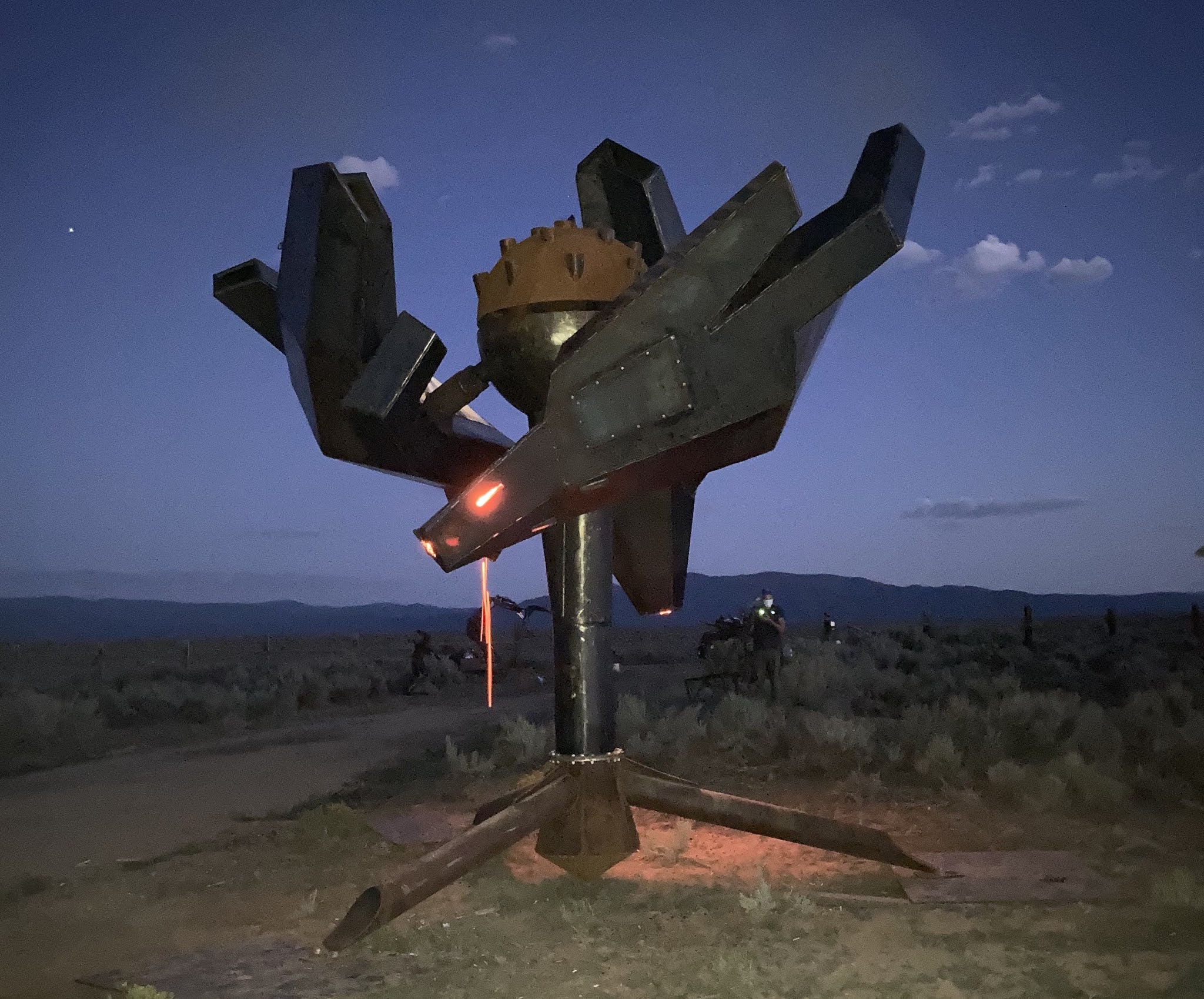
The sculpture has two modes: open and closed. It will stay in its closed position for the next few months while it accepts paper notes from visitors. And then, sometime in the fall or winter, we will load it full of firewood and burn all those notes and wood and the burning of all that fuel will cause it to open. This will be the first time the general community gets a chance to see it in the open position, but we did to a test-burn a few nights ago in order to verify the function of the piece, (it mostly worked) and so we have already seen it open.
Capsule Closed


Capsule Open


I must say that I was surprised to see how different the piece looks in its two modes, and how much I like it in the open mode. In the open position the sculpture reminded me of what is probably my favorite abstract sculpture, Spomenik #4. Spomeniks are a group of brutalist non-figurative concrete war monuments in the former Yugoslavia, and although I am no lover of abstract art, the power and appeal of these sculptures is undeniable. 

Spomenik #4 (as titled by photographer Jan Kempenaers) featured on the cover of his great book


Capsule is not technically abstract, as it loosely depicts a fragile globe protected by three hands, but it's probably as close to abstract as I've ever gotten, personally. The unexpected resemblance that I personally perceive between Capsule and Spomenik 4 is a relief, and a point of pride.

It probably should come as no surprise that both Christina and I, being people who have built lots of art which includes ambitious large sculpture, are control freaks. We both have strong visions and we both usually feel committed to seeing those visions actualized... as we see them. Naturally, this makes for some challenges when trying to work together for the first time. I would say that, overall, we did well in this department, and we could do better. As for the interesting question of whether the piece itself is better as a result of its having been the product of two artistic visions smashed into one, or if on the other hand a single unadulterated vision would in general produce a better result... I'm probably not the right one to make that judgment. I do think Christina brought elements to the sculpture that I never would have considered, and vice versa. So I suspect that yes, the piece benefitted. It's like a metaphor for parenting, or for a relationship.

Capsule Artists


We will work with our partners (THANKS CeCe and Matt!!) to determine the right date for the burning reveal of Capsule. It will likely be in the fall or winter and the date will be broadcast all over the Capsule networks, so stay tuned.

As I said at the beginning of this post, I have so much to write about. Capsule was a big part of it, but look for another blog post, hopefully in just a few days, in which I will catch us up on all the other stuff going on, such as 
Camille Paglia
The elusiveness of unstructured thought
My new sculpture prototype
My bookplate, and 
Crickets

Hasta pronto

Thursday, June 18, 2020

Look Out!! Or in...

A few days ago while reading the introduction to a book called "Legendary Artists and the Clothes They Wore" I came across the line "The job of artists is to critique culture, unload their psyches into their work, and make edifying masterpieces the rest of us can revere."

The line feels like a bit of a throwaway... an obligatory expository step on the way to the real meat of the book, but... I couldn't get it out of my head.

The sentence describes three things that artists are supposed to do. The third thing in the list, "mak[ing] edifying masterpieces the rest of us can revere," is really just a catch-all description meant to encompass any work of art which is worthy of our attention. The first two items on the list, however, are what caught my interest.

1) Critique culture.
2) Unload their psyches into their work.

I believe that this is a major distinction which divides the subject matter of art into two subsets: Looking outward and looking inward.

An artwork which critiques culture sets its sights on the world around us. The artist points their gaze outward, away from (him/her)self, and seeks to make a commentary on the society or culture that we all live in. Often this takes the form of some sort of evaluation, or illumination of something the artist feels needs to be examined more closely, and as such this type of art is often part of a cultural dialogue around issues like social change and justice. Artists whose work typically functions in this way include Banksy, Ai Wei Wei, Alice Walker, Taos artist Nikesha Breeze, and my old friend Chris Dacre, among many others. It's also true that every work of art, even those which seek exclusively to critique culture, bears the stamp of its maker, and is therefore personal to some degree.

An artwork which functions primarily as an unloading of the artist's psyche is an artwork that looks inward. This sort of work typically takes topics like emotion, romance, and mortality as its subject matter. These topics might be collected under a subject heading such as 'the fundamental experience of being human,' and might further be classified with terms such as 'psychology' and 'biography.' Artists working in this mode include Egon Schiele, Francis Bacon, Chuck Close, Tim Hawkinson, and Anton Solomoukha. 

These are broad distinctions, and I don't think they encompass all art. For one thing, painting before the advent of photography often functioned simply as a document of noteworthy people and events and this type of painting doesn't really fit into either of the above categories. Also, abstract art (which I usually think of as 'art about art,' and which I generally dislike) also defies these definitions.

And then there are the artists who transcend this distinction, either by crossing over, back and forth, between the two points of view or by defining some interzone between them. This work, I think, has the potential of being particularly powerful. A few artists that come to mind who have managed this feat are Jean-Michel Basquiat, Paul McCarthy, the amazing Marina Abramowic, and perhaps even Ingres. I count these artists as some of my favorites. Incidentally, I believe that film is very well suited to handle this sort of multi-focus crossover; after all, visual art is typically one image while a single film comprises thousands.

My favorite psychology author is the late Alice Miller. Her lifelong focus was child abuse and neglect, and the ways in which the effects of these traumas linger (often unseen) into adulthood. In her book "The Untouched Key" she traces the effects of childhood trauma in public figures such as artists Chaim Soutine and Pablo Picasso, philosopher Friedrich Nietzsche, and dictators Adolph Hitler and Joseph Stalin, showing how abuse and neglect they experienced in their early lives led either to great art or horrible cruelty (depending on critical factors which she does identify). According to her formulations, the work of Soutine and Picasso crossed over between the realms of the inner and the outer, even though the artists themselves were to some degree unaware of the psychological forces at play in their own art. *See below for a bit more about Alice Miller.

But, back to the dichotomy.

I'm guessing that, among the segment of the population which actually gives a shit about art, most people have a preference between art that looks inward and that which looks outward. I do. I prefer to see the psyche of the artist; I prefer work that looks inward.

It's not a strong preference; by no means will I 'write off' art that critiques culture. Some of it is amazing, and amazingly powerful. Banksy routinely makes me chuckle and sometimes makes me think about just how fucked up this world is... in ways that are funnier and more insightful than just reading the news does.

But whereas art that critiques culture is by its very nature 'timely,' dealing with issues that need to be addressed now, inward-looking art is, I believe, more 'timeless.' Questions of what it means to feel love and pain, joy and suffering and loss and death... these are questions which are for everyone, across all time.

So I will take Francis Bacon over Ai Wei Wei any day. 


It must be because I am still trying to understand my own psyche, and I look to other artists for insight and guidance. I trust the sincerity of their curiosity... about themselves. That must be why artist biographies are my favorite genre of books.

Maybe one day I will 'figure myself out,' and maybe I will, at that point, mature into someone who gravitates more to the culturally critical variety of art. It seems like a reasonable possibility. Maybe.


___________________________________

I consider 'music biography,' or books that trace the careers of musicians, to be a genre which is very closely related to 'artist biography.' Among the few books that I've actually finished in the last few years are biographies of Leonardo DaVinci and Francis Bacon, as well as books about Leonard Cohen and Joy Division. In order for me to finish one of these music books, though, it needs to be well written and it needs to be about a musician (or group) that I actually like. 

I recently received in the mail a newly published book about The Sisters of Mercy, a band I like a lot because... you know, I was a teenage goth. And goddamn, is it well written, because... you know, it was written by my brother, Trevor Ristow. 

I've only had the book for about 36 hours and I'm more than half-way through it. 

I have to say... I am really proud of him. 

He self-funded the publishing and was therefore only able to print 200 copies, which sold out immediately. But there is hopefully a second printing coming soon. Click here for more info.

Nice work, Trev!

_____________________________________

*A bit more about Alice Miller: Her most famous book is The Drama of the Gifted Child. It's amazing; I've read it twice. 
The logical conclusion of Miller's views is that the history of art and the history of the world is a document, a legacy, of the childhood treatment experienced by history's main actors. It's a fascinating theory which makes a lot of sense. 
She contends, in The Untouched Key, that Hitler and Stalin were products of neglectful, abusive, and traumatic childhoods, and that, as adults, they turned the terror they had endured as children back onto the world. 
These insights bring a sense of urgency and importance to the upcoming book by Trump's niece, psychologist Mary L. Trump. Ms. Trump's family history apparently describes "a nightmare of traumas and destructive relationships" and promises to “explain how her uncle became the man who now threatens the world’s health, economic security, and social fabric”. I couldn't have said it better myself. Sounds like an important book. Read more about it here.

Monday, June 8, 2020

Bullet Points

I'm calling this post "Bullet Points" because I'm going to try to write leaner, sharper, less indulgently, and perhaps over a wider range of topics.

• • Plus, I like bullet points. • •

• Way back at the beginning of the pandemic, I wrote that I was really enjoying it because we had so much more time. That was wishful thinking. I tried to make myself believe it,.. and yes, we were driving less.. but having your 9-year-old suddenly at home all the time does not create more time. Parents will understand this. Non-parents... maybe not.

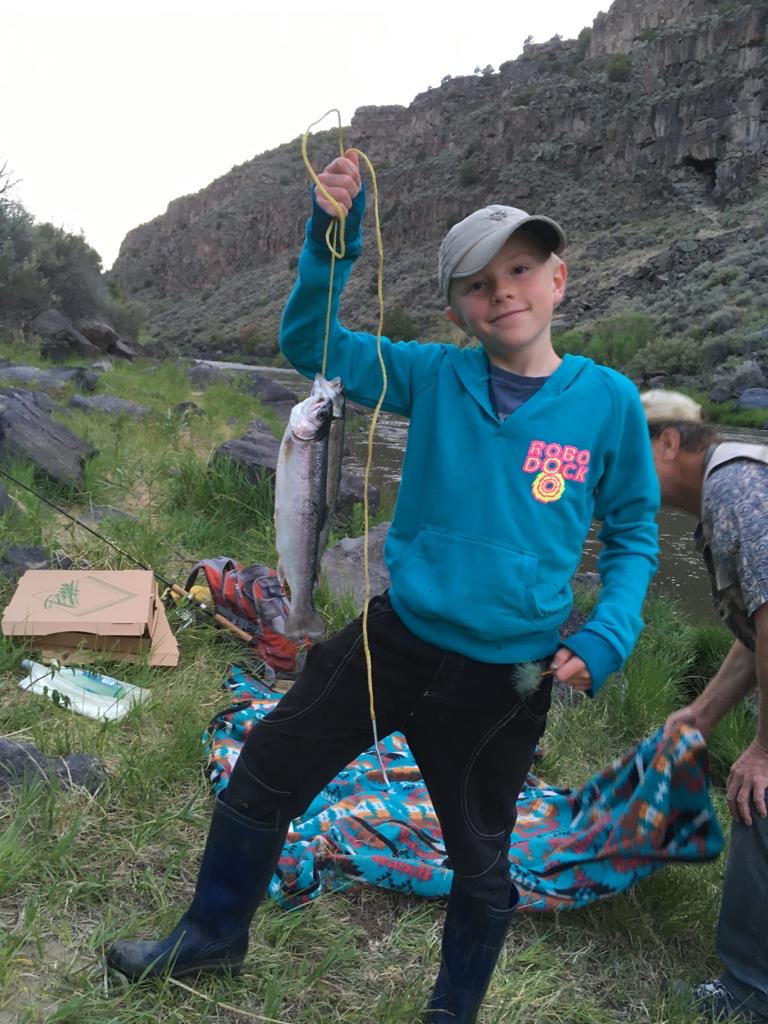
• Christina has handled the home-schooling, and I've been handling the fishing. Kodiak is a fishing maniac, and he's really good at it too. We go down to the Rio Grande a few times a week, and in the time since we started fishing he has caught 24 fish while I have caught 4. We eat a lot of trout. 


• I was recently reading about Rainer Maria Rilke and apparently he suffered an artistic crisis which caused him to take a whole decade to finish a certain book. This made me feel more OK about my little artistic crisis. I'm trying to be a little less hard on myself.

• Christina and I recently got a commission to build a new sculpture for the little town of Arroyo Seco, just north of Taos. It's gratifying to get a cool new job like that, during this pandemic/lockdown/COVIDcrisis. We have to bang out the sculpture in about 6 weeks, and... we are working together... actually collaborating... for the first time ever! The sculpture is called Capsule and you can keep up with it here and here.

• 2019 was a bit of a tough year for Christina and me, as a couple. 2020 is shaping up to be a lot better. It's not something I write about so much on my blog, but Christina is an amazing woman and I am lucky to have her in my life. I love you, Sporrong!

• I've written before on this blog about the psychological component of the divide between right and left, and I continue to be fascinated by it. In my last post I said I had an observation to make about politics, and it's this: Conservatives seem to need certainties, while progressives seem to be more comfortable with uncertainties. Trump and his supporters seize on any new possible treatment for COVID19, declaring it the 'wonder-cure' before the scientific results are even in. Remember Hydroxychloroquine? Liberals seem OK with actually waiting until there is a proven therapy, understanding that these things take time. Conservatives are drawn to religion in part, I think, because it offers a story that answers the difficult questions, while liberals understand that these questions might just not be answerable... and they are OK with that. And it's cross-cultural; conservative westerners hold onto Christianity, conservative middle-easterners flock to Islam, and conservative Jews are pretty into Judaism. Trump blames China for COVID, while conservative Iran blames the USA and Israel. How does this help anything? I'll tell you how it helps: it helps them feel better, having someone to blame. My guess is that it's related to the enlarged amygdala in the conservative brain and the interrelated way in which their worldview is oriented around fear. Life is disorderly, but the conservative impulse is to stamp out the disorder with 'law and order,' stamp out the fear with certainty. Conservatives need certainty. It's comedy.

• I've mentioned before that I collect original paintings from the 1970's cartoon series Wicked Wanda, but those are just one part of a modest art collection that I add to when I can. I just acquired this quartet of drawings from Allison Reimold.


• I've recently come up with a new idea for a large-scale mechanical sculpture, and it's quite interesting to note how inspired I feel by the challenge of building complicated big machines. I'm already beginning to work on a small prototype of it... you know, in my spare time!

• As part of the process of working on Capsule, Christina and I have busted out the clay to work out some of the forms, and that has inspired me to work on another clay sculpture... another portrait / bust. I also picked up some really sculpturally-interesting tree-parts the last time I was at the lumber yard, which are inspiring me to build another human-scale piece like Big Mother. Sometimes it seems like the biggest challenge for me is WHERE to focus the creative energy... big sculptures, or small prototypes, or human-scale tree-sculptures, or paintings, or clay portraits? Hell, I'm a frickin' Renaissance-man. Or at least I would be if I had the time. 

• For now... Capsule. Stay tuned. 


Spring time in Taos is motorcycle season.
(The white tube is for fishing rods!)


And it's beautiful.


Thursday, May 7, 2020

Going Lee Bontecou

At some point, in the not-so-distant past, I tried to sum up the various categories of subject matter that I typically cover with my blog. In short, it's art and art-making; travel and adventure; psychology and self-analysis; politics; and occasionally some other stuff.

This post looks like it will a bit of all of the above... maybe with the exception of travel and adventure. 
(*EDIT* When I started this post, with the above sentence, I thought this blog would touch more on art-making and a little bit on politics (and I do have some things to say about those topics - in another post), but now it seems like this one is mostly self-analysis. If you don't like psychology and vulnerability, or if you're tired of me whining self-indulgently about my art career (!), skip it.)

Here goes.

I've been mulling over this post in my head for quite a while now - its birth has been slow and painful - and a thesis statement has slowly formed. It goes something like this: 
It turns out that the art-career advice that I managed to put together in my recent post entitled 'Just Keep Doing Your Thing, Man!', inspired by the situation of my musician friend 'Frederic,' was, unbeknownst to me, actually advice that I need to be giving to myself; and furthermore it's advice that I am apparently not very good at following.

In my last post I spoke briefly about trying to get my painting as close to finished as possible in time to apply for an open call at the Harwood Museum. I put a lot of work into it leading up to the deadline date, photographed it, and then set it aside for a while to focus on some other things. One of those other things was the controller for a mechanical sculpture that I also submitted to the Harwood. It felt good to get the controller done, as it meant that the sculpture, which I built in 2016 for Meow Wolf, was finally really finished. 


A few weeks later I learned that the Harwood decided not to select either the painting or the sculpture.

The sad part of this, the micro-tragedy, is that I let this rejection totally derail me. 
I had intended to take a hiatus from the painting for only a few weeks, but after being rejected from the show I had no desire to get back to it and its been six weeks now that I haven't painted.

The natural inclination of the human mind is to look for a reason. But when your painting (or sculpture or album or film or...) is rejected, no reason is typically given. So you wonder, and you start making stuff up. "Oh, the Harwood is too conservative for my stuff," you tell yourself. Or "they couldn't take the risk on something unfinished." Or "they were only looking for artists with proven histories in galleries." Or "They can't handle full frontal nudity." Any of these might be true, but you just don't know. The one reason you don't want to believe is "my work just isn't good enough," but of course that is the reason that actually haunts you. 

Around this time last year my proposal for Burning Man was rejected.

A few months later I submitted two proposals for Electric Daisy Carnival; both were rejected.

No one ever gives you a reason. 

In 2004 I saw a show at the NY MOMA by an artist called Lee Bontecou. I like her work, but what REALLY got to me was her story. I've never forgotten it. 
In the 1950's and 1960's she was very involved in the NYC art scene, frequently showing her work publicly. In 1970 she staged a show that was poorly received and her response was to leave her gallery and retreat from public view for several decades, but to still keep workingFor years and years she produced work on her own, listening to only one critical voice - her own. She was 're-discovered' in the early 2000's and her big retrospective was mounted at various major museums across the country, including the MOMA in 2004.
Her story lives in me like a myth. In fact I may have even mythologized (distorted) certain elements of it over the years, as I frequently think back on her story of bravery and independence.

Since I was a child I have been making things, making art.
In 1988 I learned to weld.
In the early 1990's I discovered 'robot theater' through my association with SRL
In the late 1990's I branched out by doing my own robot theater shows in LA. Notability and publicity came easily, especially after I began working with Coachella. Shock value and mechanical violence are attention-grabbing; the external validation was abundant. This continued through to about 2005.
In that year I met Christina and moved to Taos, and although I didn't quite see it yet, a new artistic phase was just around the corner. In 2008 that phase began with the Hand of Man, my first big interactive mechanical sculpture. Several more were born over the following decade. Large scale and mechanical violence are attention-grabbing; the external validation flowed. 
But the real meaning of all this work was elusive. Those robots and robotic sculptures... if they revealed anything about their maker, it was precisely through their mechanical shielding of anything personal. Becoming Human might have been the closest I ever got. In 2018, while living in Berlin, the idea of painting first occurred to me... as a medium through which I might be able to say something a little more personal. But I didn't know how to paint then, and even though I'm much better at it now, it does not come naturally. The idea of picking up the paint brush again, after six weeks, seems daunting, fraught with self-doubt. In contrast, the idea of welding or machining or designing something mechanical seems so easy; I could do it in my sleep. Christina calls mechanical design my 'Super Power.' But can I say anything meaningful with that medium? This is one of the questions I currently grapple with. Or maybe, the fact that painting feels so foreign to me is precisely the reason I should stick with it. 

I feel like I need to 'Go Lee Bontecou' for ten years, and figure it all out. 

My proposals for big sculptures are all falling flat. I think they are too personal, too narrative, and in some cases too 'challenging,' (too dark?). The cosmos is telling me to shift gears. The subject matter that feels relevant to me is apparently not well-suited to the 22-year-old MDMA-powered party world of festivals. But... perfect subject matter for painting. Or... for forging some new kind of artwork... some melding of my super-power with the more deeply personal content I'm trying to channel through painting. 
(I sometimes think about those people who trained for years for careers which then went obsolete as the world, and technology, changed around them. Adapt or die.)

As I was advised recently, I will have to cognitively adjust to a reduction in external validation.
I can imagine what it would be like to 'inhabit' that person who just didn't listen to anyone else, who just pursued his own vision... almost in a vacuum. But it seems I am not that person, not just yet.
Have some courage.
Just keep doing your thing, man.
Go Lee Bontecou.


I have actually been doing a little art-making. 20 years ago a friend asked me to custom-build for her a headdress featuring two Barbie Dolls mechanically... 'interacting.' The project turned out to be really fun - small scale, mechanically challenging - on the scale of animatronics, and irreverant (to put it politely.) Over the years I've made a further small number of similar sculptures. I've recently put a little time here and there into finishing another... but they are so spectacularly NSFW that I can't show them here.... or anywhere, really. But they're fun, and they satisfy my drive to create, in those temporal interstices. 


Thursday, March 26, 2020

Welcome to the Pandemic

This is my first blog post from the COVID-19 pandemic.
I'm sure it won't be my last.

I had two exciting engagements for my big sculptures scheduled for this summer, and both of them got cancelled on Monday of this week. I wasn't exactly surprised, but... disappointed nonetheless. 
All things considered, this is a small price to pay in these extraordinary times; many people are suffering much more than we are. But still, a bit of a bummer.

One gig involved installing With Open Arms in San Jose, California, in front of the San Jose Art Museum for the entire summer. This would have been a prestigious location and I was looking forward to it.
The other gig was a week-long exhibition of Hand of Man and Fledgling in Rijeka, Croatia, in connection with that city's status as a European Cultural Capital for 2020. That show was going to facilitate a 2-month long stay for Christina, Kodiak, and me in Europe this summer, a trip which also seems indefinitely 'on hold.'
Both shows are technically 'not cancelled, just postponed to some unknown time in the future,' but I can imagine that this status could shift to 'cancelled' quite easily, depending on how things go.

Both of these engagements have been in the works for over a year. And now, in one day, both are cancelled or indefinitely postponed. It's just one example, my little example, of how quickly and drastically things are changing these days. 

But it turns out that Taos, New Mexico... the sweet little town I call home... is not such a bad place to be in a time like this. And living outside of town, on a few open acres of land, with no real job (to lose) and no mortgages also has its advantages. This time of 'lockdown,' of radically reduced travel and social interaction, does not really feel very different from regular everyday life for us. The biggest differences are that we are driving MUCH less, and that school has been cancelled for the next few weeks (and I think it will remain closed for longer than that) and so Kodiak is at home with us all day, every day. This brings some challenges, but also plenty of blessings. It's great to have the opportunity to spend more time with him and I know he enjoys the time with us. He has always expressed a wish to be home-schooled, and now that Christina is playing teacher (with daily lessons in reading and math, sent from his school by email) he is finally getting that wish. Plus, he gets to see what sort of work Christina and I do on a daily basis. It's a nice time of family integration. And when he is not learning, he has a trampoline to jump on, acres of land to explore, a workshop to tinker in, and animals to play with (and feed!). All of this, only a few miles from a politically progressive small town blessed with good weather, good people, and surrounded by abundant nature. Increasingly, I have a hard time imagining myself living anywhere else in America. 

Speaking of daily work, since we have been in lockdown (it's only been a week so far) we have gone crazy with home-improvement projects. In fact I almost feel more busy now than I did before this country got slammed by COVID-19 ten days ago. 


We have begun a moderately ambitious project to build a roof over our deck.... 


I built a loft-bed for Kodiak...


 and we totally reconfigured his room...


And we reconfigured our living room. I'm getting some long-delayed sewing projects done. Next up we will repair and improve our ranch gate... 


the gateway to our land. Check out Huginn and Muninn, perched on the gate! (You can barely see it in this picture, but the gate is tied to the Subjugator to keep it from falling over)
And after that... more projects. 

In fact, so far I am really enjoying this shut-down of society as we know it. It is suddenly acceptable to be completely asocial. It is perfectly OK, actually it is strongly advised, to just stay home and get shit done. I know that some people feel adversely affected by the sudden removal of all social interaction, it seems some folks are actually having a very hard time with this aspect, but I guess I'm not one of them. I am lucky to have my amazing little family here, and so far we are having a sweet time, socially isolated on our little piece of dirt. 

About 2 weeks ago I had to step away from my painting to focus on other projects, but for several weeks leading up to that time I was totally 'in the zone.' I was painting every day and making great progress. At this point I am really still working on my first 'real' painting, but I'm about 90% done and can't wait to get back to it. I'm pretty sure I will post a picture of it here when it is finished. 

The closest thing to a serious and recognized art museum in Taos is called The Harwood, and for the first time in 17 years the Harwood recently put out an open call for submissions from local artists for a group show of Taos art. Christina and I both applied. I submitted a kinetic sculpture of a robotic hand as well as my painting, unfortunately in an unfinished state (but with a promise to finish it soon.) Fingers crossed; it would be fun to have my first painting accepted into a museum show. 

Back when we lived in Berlin I observed that looking at art seemed to have a calming effect on me. I don't feel hugely effected by this coronavirus crisis... but I think it is a background stress factor for me, as it must be for anyone else who is paying attention. In fact, part of the reason I can surmise that it is a stressor is that I have an increased desire to look at art. If the Met were open right now, and within reach, I would be spending the day there (wearing a mask and gloves.. or whatever... you get the idea.) Art, for me anyway, sends a message of historical continuity, the persistence of human endeavor, the enduring effort to be creative and make beauty. I feel like these are good things to remember, in these times.

The last TV series we watched around here was Fleabag... which comes with my very highest recommendation... and now we are watching something called Outlander. Outlander is sometimes pretty cheesy... occasionally having the feeling of a romance novel, but it is anchored by a really stellar performance by its lead actress. In fact I think the strong female characters at the centers of these two shows are what really recommend them. My cup of tea, anyway. (I'm considering painting portraits of the protagonists... Too cheesy? Maybe.)

If you are reading this, it means I count you as a friend... and I sincerely hope that you are finding a way to get through these unprecedented times without too much hardship.
A lot of people are going to face some tough decisions, but I think there are real opportunities for a re-structuring of priorities and lifestyle choices which could, in the end, prove to be positive... providing we all actually survive. 
Be safe. Survive. Be productive.
In that order.
Well, that's what I think.

Cheers

Thursday, January 30, 2020

Just keep doing your thing, man!

OK, first off I would like to point out that the last post provoked a pretty interesting conversation in the comments section. If you found the last post intriguing, have a look at the comments.

But now, on to other topics.


I recently had a conversation with a friend about a guy we both know, a common friend of ours. Let's call this third person (the subject of the conversation) Frederic. Frederic is a musician, and has achieved a certain level of success, having released several albums and played live shows and tours all over the world. However, as revealed in this recent conversation, Frederic is frustrated that his success seems to be peaking, or topping out, and he has not yet achieved 'recognizable household name status'; he's not a superstar.


But this is where the conversation got interesting. Frederic is what I would call an 'artist with integrity.' He is trying to do something which is personally meaningful to him, and which also has a politically engaged dimension, and is in fact succeeding quite well at this, at least in my opinion. But this effort, guided as it is by a strong and highly personal internal compass, puts him 
almost by definition into a bit of a niche.

I think that artistic work which manages to 'hit the jackpot' of widespread cultural acceptance gets there for a variety of interconnected reasons (such as timing, artistic skill, promotional visibility, etc.), and I think that luck (or chance) also plays a role in the process, but the point of this sentence is that I think it's frequently true that work needs to have an element of non-specificity, of universality in order to 'make it big.' (Just think of those vague and generic lyrics in your favorite tune by U2 or Justin Bieber!) This, then, is the corollary question: "Is widespread cultural acceptance (hitting it big) fundamentally incompatible with a strongly held, highly personal vision, especially when there are elements of that vision that are 'challenging' in some way?"


I think the answer to that question is probably "No these things are not fundamentally incompatible, but they are not frequently seen together and when they are, chance has played a role." One way that chance can influence this process is that something in the artistic work might happen to coincide with something current in the zeitgeist, which is always evolving. Artists can of course intentionally try to 'ride' something they see in the zeitgeist, which can be seen actually as an attempt to engineer a sort of universality; after all anything floating through the zeitgeist is by definition universal, at least for the moment.


In a sense this idea of 'hitting it big' hinges on the fantasy of the 'one big thing'; the hit album or hit song or hit sculpture or painting... the one thing that everyone notices and makes you suddenly famous.

But... there is another way.

And that other way is....

Just keep working. Stay true to yourself. Continue to evolve. And just keep making the work.

And then, slowly, over the years, you gain a different kind of fame... a kind of esteem among your peers. And this sort of renown can often be achieved even when the work is challenging.


The world is full of great examples of people who embody this approach, but the one who came to mind as I was having this conversation was JG Thirlwell, better known as Foetus. He came to mind not only because he is one of my favorite musicians but also simply because he IS a musician, and we were talking about musicians, and he provides a potent embodiment of the the 'just keep working' model, a potent counterpoint to the 'one-hit-wonder'.


JG Thirlwell is not exactly a household name in the world today; in fact he's somehow managed to stay comparatively obscure. But the guy is really a musical genius, and his prolificness (I checked... it's a real word) leaves most of the rest of us in the dust; just glance at his impressive discography. And here's the thing: his work has always been challenging, and therefore niche. A quote from his Wikipedia page: "Recurring lyrical themes include destruction, persecution, anxiety, abuse, incest, masochism, angst, self-destruction, self-abuse, lust, prejudice, murder, failure and machismo, often expressed using American colloquialism and black humour.
" Yet, somehow, he has transcended the self-ghettoizing consequences of this sort of lyrical output to become, over a career of 40 years, highly respected and sought-after by other professionals not only from the music industry but from other parts of the entertainment industry as well. And how did he manage this? Well my theory is that it's because he is fiercely original, hard-working, and therefore prolific. 


It's really about persistence, and staying true to your self and your vision. If you just keep doing your thing, the world will eventually catch up to you. 

OK, not everyone can be the next Taylor Swift, but would you really want to be? Sure, the piles of cash sound fun, but I can only imagine that one sacrifices a lot of freedom for a life like that. 

Just keep working. 


(For a taste of two different, not overly 'challenging' sides of Foetus, click here and here. And believe me, if those tickle your fancy, there is SO MUCH more to discover.) 


_________________________ 

OK, change of topic. I've been painting for days, maybe even weeks. I finally got into the swing of it. It's slow work. Painting crumpled fabric is especially slow. 


I keep discovering new painters I like. 

I'm currently rather enthralled by Mati Klarwein
I've even developed a real respect for Alex Grey
With both of these guys the subject matter is a little hit-and-miss for me, but I love the precision and the highly personal vision that they both espouse. 
I continue to be fascinated by Ingres and Caravaggio


_________________________ 

Last week Kodiak and I checked out the Jim Henson exhibit at the Albuquerque Museum.


It was a great show. What an inspiring guy. The Jim Henson Creature Shop was the first place to hire me when I moved to LA to get into Animatronics, and although Jim was dead by that time I did meet his son Brian. 
One thought that I had when seeing the work on display was... "I know how to do all this stuff, to build these sophisticated puppets, and it's an unusual and versatile skill, and it's a bit of a shame that I don't do more with it.... I should build some puppets, and... Have a puppet show!"


Head mechanism I built for some puppet or another, incorporating eye mechanisms and multi-axis ears.


Doctor Octopus's upper two claws from Spiderman 2, which I built and puppeteered on set.

Build puppets and have a puppet show? Hmm... we'll see about that. 
Anyway the Henson's exhibit was a good show.

(And how's this for a tie-in... click here for Foetus doing a cover version of Elton John's 'Rocket Man' with lyrics re-worked as 'Puppet Dude,' a tribute to Jim Henson!)

_________________________ 

And lastly, a few people picked up on my brief discussion of the Datsun 240Z from several posts ago, and asked if I would in fact write a whole post about that car. Well I really don't think I will do that; there is so much already on the internet about that car and I would mostly just be regurgitating info that's already out there. Suffice to say that I have owned two of them and I love them. They're very fun to drive. 

Check out this recent auction of a totally original 1971 240Z that sold for.... $310,000! 
Holy guacamole! 

I'll leave you with this, the 240Z from Mad Max: Fury Road... You had to have a sharp eye to catch this car in the film... it's barely in there, but I saw it immediately.


Adios, muchachos y muchachas